
Showing posts with label Spy Eyes. Show all posts
Showing posts with label Spy Eyes. Show all posts

Taliban’s claim of slaying 23 Frontier Constabulary (FC) personnel has torpedoed the peace parleys as government negotiators put off their Monday meeting with TTP-nominated team, and the civilian and the military leadership reportedly decided to launch a decisive action against the terrorists.
The meeting of the peace negotiators was cancelled on the directives of the prime minister, who told the government negotiators that such gruesome acts of terrorism could not be tolerated and that in the face of such terrorist activities the peace talks have become meaningless.
“The lives of our children are extremely precious,” he said in a meeting with Irfan Siddiqui and Maj (r) Amir on Monday morning. The PM said that the killing of the security personnel could not be allowed in the garb of negotiations. The terrorists through their negative tactics have sabotaged government efforts to negotiate peace, he added.
The peace process has gone into disarray just two weeks after the talks began, when Sunday night TTP claimed to have killed 23 FC men they had kidnapped in 2010.
A media report said that a gruesome video was released on Monday by the terrorists, showing beheaded bodies of FC men being thrown out of a pickup van. The report, quoting army sources, said 26 bodies of the martyred soldiers had been found near the Pak-Afghan border later in the day.
TTP Mohmand chapter chief Umar Khalid Khurasani in a letter posted on the social media had said the FC men had been killed to avenge the killing of their men in government custody in various parts of the country.
Spokesman for the main TTP group, Shahidullah Shahid had earlier declined to confirm the killings but said “it might be a reaction to the killing of our 23 comrades in Karachi and Nowshera”. The TTP spokesman alleged their under-custody members were being killed in the name of targeted operation. He claimed that 23 Taliban members had been killed during the ongoing dialogue process –15 in Nowshera and 7 in Karachi.
Sources said the government and the military leadership has decided in principle not to hold talks any further with the Taliban and started preparations for launching a decisive action against them. They said the civil and military leadership in a high-level meeting late Sunday night decided to launch operation in North Waziristan.
According to sources, the security forces are fully prepared for action in Waziristan and are waiting for a green signal to go after terrorists. During the meeting, the prime minister said no compromise would be made on national security and no concession would be made to the terrorists. The meeting reportedly decided that the security forces will not halt their action against terrorist elements. It was decided that ground and air attacks will be conducted against the terrorists.
Special Assistant to Prime Minister Irfan Siddiqui during their meeting informed the PM that the government committee would meet on Tuesday (today) to review the changed situation. Sources in government informed that the committee would again meet prime minister who would then take a ‘final decision’ on what exactly to do with the dialogue process.
Sources also said that now the voices in favour of military operation against Taliban have grown phenomenally in the echelons of power, as the supporters of peace through dialogue have no answers to the stepped-up terrorist activities by the TTP. The argument that TTP is a loose alliance of several dozen militant groups and the central leaders of the conglomeration have little hold on majority of these groups appears to be not holding water. Many a question are being asked about the use of talking to the so-called TTP shura leadership if it has no control or doesn’t exercise it over the smaller groups.
The meeting of government- and TTP-named negotiators was scheduled for Monday in Akora Khattak, home town of Samiul Haq, who heads the Taliban designated team. But the government negotiators, Irfan Siddiqui, Amir Khan, Rahimullah Yusufzai and Rustam Shah Mohmand met in Islamabad and cancelled the meeting which had one-point agenda of ceasefire.
After this development, Taliban-named team comprising Samiul Haq, Yousaf Shah and Prof Ibrahim Khan also held a meeting at Akora Khattak and expressed their concerns over the slaying of FC men and cancellation of the meeting. Speaking at a news conference there, Yousaf Shah said that they also condemned the Mohmand Agency incident but they will not go into details over the explanations provided by the TTP.
He said it’s been heard that the government has decided to conduct operation, adding that the problems will never be resolved through force. He said military operation is not an option to restore peace in the country. He said the government shouldn’t stop the process of dialogue, and that cancellation of Monday’s meeting was disappointing.
In the same press conference, Prof Ibrahim said their committee was a neutral body acting as a bridge between the government and the TTP. He said the negotiators from both side should have met and discussed the issue. “It is sad that the government negotiators have considered us as TTP representatives and refused to meet us; we don’t consider ourselves separate from the government representatives,” he said.
Yousuf Shah in his media talk claimed there were positive signals coming from the Taliban side and they were close to ceasefire and the government should have met them. He said that Sami would soon contact Taliban and then Taliban negotiating committee would soon issue a formal statement over the attack.
TTP’s main spokesman Shahidullah, who conceded that killing of FC men by their associates might have been a reaction to the killing of captured Taliban, said that such actions by the government during talks were unbearable and harming the dialogue process. Claiming that TTP was serious and sincere in holding talks he alleged the government was making the dialogue process difficult. He said they have been thinking about the declaration of ceasefire for making the dialogue a success, but “we are reluctant because of the government actions”.
A security official said the TTP allegation of killing of terrorists in the security forces’ custody was a baseless propaganda to justify their brutal acts of terrorism. He said the killing of policemen in Karachi, FC personnel in Mohmand Agency and other continuing acts of terrorism testify that Taliban were insincere and they were advancing their bloody agenda in the garb of peace process.
In a statement issued by PM Office on Monday, the prime minister said incidents like that of martyrdom of FC personnel in Mohmand Agency cast negative impact on peace talks. “Pakistan can’t afford bloodshed anymore,” he added. Paying rich tributes to the sacrifices of the martyrs‚ he said the government initiated the dialogue process with good intentions in the light of the decisions of All Parties Conference (APC); however‚ the process is sabotaged whenever we reach an encouraging point. He said that it was highly regrettable situation and the entire nation was grieved over it.


An alarming rise in the number of killings of political activists in Bangladesh since disputed parliamentary polls has left grassroots campaigners across the country fearing for their lives.
Labelling the arrests and subsequent deaths of activists “extrajudicial killings”, opposition leaders have blamed the government for targeting opposition activists. Several ruling party activists have also been killed over the past two months.
Human rights groups fear that the crisis is likely to become even worse in coming months, if the government does not take drastic steps to bring the killers to justice.
Deaths in custody
Robiul Islam was arrested on January 27, his neighbours told Al Jazeera. “Police sources had later informed that, following a tip-off, a team of the joint forces [the police and paramilitary agencies] had conducted a raid,” said Saifur Rahman, a journalist based in Jessore. “After they were allegedly attacked by opposition activists, a gunfight ensued between the two sides, during which Robiul was shot.”
The Bangladesh National Party (BNP) activist died a few hours later, at a nearby health facility. The police alleged that Islam was involved in the killing of Chaitanya Kumar Mandal, a local ruling party leader, a day earlier.
While the names and locations change, the story remains the same across the country, as police and security forces claim those who have been shot dead in custody over the past month had themselves been involved in killings.
On January 30, Touhidul Islam, one of the BNP’s district party leaders, was also killed in a similar “gunfight” after he was arrested in Sonaimuri.
In its January 2014 monthly report, Odhikar, a Dhaka-based human rights group, counted more than 30 extra-judicial killings, “allegedly conducted by RAB [Rapid Action Battalion], police, BGB [the paramilitary Border Guard] and joint forces” – in that one month alone.
The report also said that 26 of those killed were either activists or leaders of the BNP or Jamaat, the country’s laregst Islamist party.
Atiqur Rahman, a joint secretary of Bangladesh Chhatra Dal – the student wing of the BNP - was one of those killed last month.
After being accused of attacking Cultural Affairs Minister Asaduzzaman Noor’s motorcade in December, 26-year-old Rahman had gone into hiding in Tangail, in the centre of the country.
“On the night of January 13, at least six people who claimed to be members of the detective branch of the police stormed into my house and picked up Atiqur and Mohidul Islam [Rahman's cousin and Jamaat activist],” said Babul Khan, a relative who was sheltering Rahman.
Although Rahman’s corpse was reportedly recovered by police on January 20 near the Saidpur bypass road, the family say his cousin Mohidul is still missing.
Some 302 BNP leaders and activists - and its 18 allies – have been either murdered or “disappeared” between December 26 and January 27, said Khaleda Zia, BNP chairperson, on February 4. Some 29,262 opposition supporters were arrested across the country during the same period, she said.
“Security forces and ruling party activists were behind the killings and forced disappearance,” said Zia, a two-time former prime minister.
“According to the information collected at BNP headquarters, in one month, 242 opposition leaders and activists were killed and 60 were victims of enforced disappearances,” Zia told reporters.
The fear of arrests and extrajudicial killings has gripped political campaigners.
“Naturally, there is a confusion and fear especially among our grassroots activists,” Ruhul Kabir Rizvi, the BNP’s joint general secretary, told Al Jazeera.
He said the pervasive trend of extrajudicial killings and attacks, allegedly pushed by “the dictatorial government”, was dampening the spirit of party workers and leaders. “But it is also enforcing their collective belief and will to fuel the movement against such oppressions,” he added.
Attack on ruling party activists
The murders have not been confined to opposition activists, however.
Since January 6, the day after Bangladesh’s widely discredited general election, at least nine ruling party officials have been murdered, mostly in attacks by opposition supporters, local media reports.
The latest victim was 30-year-old Mahbubur Rahman Rana, who was attacked by four or five men on January 23 at Dhaka’s Moghbazar intersection. Witnesses said the attackers wore helmets and swooped on Rana when he was trying to start his motorbike at the busy junction at around 6:30pm.
After shooting and stabbing Rana, the assailants fled the scene. Rana was declared dead by doctors after being rushed to the Dhaka Medical College Hospital.
On January 17, Fazlur Rahman, a local government chairman and an executive member of Natore district’s Awami League, was killed in an attack in the district’s Singra area.
Relatives of those killed worry that the people being arrested for the murders of their loved ones are likely to be innocent.
“The police have recently informed me that some of the miscreants who killed my husband have been arrested,” said Shamsun Nahar, a resident of Satkhira in Bangladesh’s south-west. Abu Raihan, Nahar’s husband and a ruling party activist, was beaten to death by a mob of masked men on November 21.
“I think the people arrested were not involved during the murder,” she added.
Ruling party MP and State Minister for Home Affairs Asaduzzaman Khan Kamal told Al Jazeera that perpetrators would be brought to justice. “The police are doing everything to arrest the murderers of the nine ruling party activists,” he said.
When asked about the deaths of opposition activists, he replied: “There is no extrajudicial killing in Bangladesh.”
“The deaths [of opposition activists and leaders] are due to exchanges of fire between the law enforcers and the criminals. They are armed criminals. When the police go to arrest them or raid their hideouts, they open fire on the police who fire back. That is how the criminals die. As far as I know, they are all criminals, accused in numerous cases.”
Little confidence
Human rights groups fear the worst for Bangladesh’s politics if the killings of political activists continue.
“The rate of killings have increased at an alarming rate,” said Nur Khan, director of investigations at Ain O Salish Kendra (ASK), a human rights organisation in Dhaka.
ASK noted 33 extrajudicial killings during January. Last year, they recorded more than 200 extrajudicial killings in Bangladesh.
“The targets are mostly opposition activists and leaders,” said Khan. “If the opposition is not allowed to practice their democratic rights to protest, they will eventually look for other alternatives.
“If political killings continue, the rise of armed religious political parties will be inevitable in Bangladesh.”
Human Rights Watch has urged Bangladesh’s government to bring a halt to the deaths.
Brad Adams, executive director of the Asia division of Human Rights Watch, said the repeated use of “the same story” – that of a detainee somehow being shot when taken to the scene of an alleged crime – was “ridiculous”.
“These stories are even less believable when the victim is a politically unpopular person,” he said. “The authorities simply have no credibility when they make these claims.”
Under successive governments, Bangladesh has a long and well-documented record of extrajudicial killings through alleged “crossfire”, Adams told Al Jazeera: “[The] BNP, the caretaker government and Awami League have all used security forces against political opponents.”
He stressed that law enforcement agencies “should operate on a professional basis, free of political pressures”.
“As long as this continues, the public in Bangladesh will have little confidence in law enforcement agencies.”

Russia has fewer satellites in space than the U.S. or China, but it is the undisputed leader in terms of the amount of debris it has left floating about the Earth’s orbit, according to figures released Friday.
The U.S. accounts for one-third of the world’s spacecraft, with 371 U.S. satellites orbiting the Earth, followed by China with 113 satellites, and Russia with 111, a report by the Central Research Institute for Engineering said, Interfax reported.
The three top satellite operators also lead the world in terms of the amount of space debris they produce. Russia is the worst offender with 6,125 pieces of space trash in orbit, followed by the U.S. with 4,627, and China with 3,672.
By Oct. 31, the total number of objects in the Earth’s orbit had reached 16,886, including 1,153 spacecraft and 15,733 inactive “space objects.”
Some 80 percent of all space debris is concentrated in low Earth orbit, causing concern to grow among research scientists and space officials in recent years.
Russia has also been blamed for environmental damage caused by one of its Proton-M rockets exploding near the Baikonur Cosmodrome this summer. Kazakhstan has asked Russia to pay $89.5 million in compensation for the damage inflicted by poisonous chemicals released in the explosion.”

The Mail on Sunday today reveals shocking new evidence of the full horrific impact of US drone attacks in Pakistan.
A damning dossier assembled from exhaustive research into the strikes’ targets sets out in heartbreaking detail the deaths of teachers, students and Pakistani policemen. It also describes how bereaved relatives are forced to gather their loved ones’ dismembered body parts in the aftermath of strikes.
The dossier has been assembled by human rights lawyer Shahzad Akbar, who works for Pakistan’s Foundation for Fundamental Rights and the British human rights charity Reprieve.
Filed in two separate court cases, it is set to trigger a formal murder investigation by police into the roles of two US officials said to have ordered the strikes. They are Jonathan Banks, former head of the Central Intelligence Agency’s Islamabad station, and John A. Rizzo, the CIA’s former chief lawyer. Mr Akbar and his staff have already gathered further testimony which has yet to be filed.
How the attacks unfolded…


‘We have statements from a further 82 victims’ families relating to more than 30 drone strikes,’ he said. ‘This is their only hope of justice.’
In the first case, which has already been heard by a court in Islamabad, judgment is expected imminently. If the judge grants Mr Akbar’s petition, an international arrest warrant will be issued via Interpol against the two Americans.
The second case is being heard in the city of Peshawar. In it, Mr Akbar and the families of drone victims who are civilians are seeking a ruling that further strikes in Pakistani airspace should be viewed as ‘acts of war’.
They argue that means the Pakistan Air Force should try to shoot down the drones and that the government should sever diplomatic relations with the US and launch murder inquiries against those responsible.
According to a report last month by academics at Stanford and New York universities, between 2,562 and 3,325 people have been killed since the strikes in Pakistan began in 2004.
The report said of those, up to 881 were civilians, including 176 children. Only 41 people who had died had been confirmed as ‘high-value’ terrorist targets.
Getting at the truth is difficult because the tribal regions along the frontier are closed to journalists. US security officials continue to claim that almost all those killed are militants who use bases in Pakistan to launch attacks on Western forces across the border in Afghanistan.
In his only acknowledgement that the US has ever launched such attacks at all, President Barack Obama said in January: ‘This is a targeted, focused effort at people who are on a list of active terrorists, who are trying to go in and harm Americans.’
But behind the dry legal papers seen by The Mail on Sunday lies the most detailed investigation into individual strikes that has yet been carried out. It suggests that the US President was mistaken.

The plaintiff in the Islamabad case is Karim Khan, 45, a journalist and translator with two masters’ degrees, whose family comes from the village of Machi Khel in the tribal region of North Waziristan.
His eldest son, Zahinullah, 18, and his brother, Asif Iqbal, 35, were killed by a Hellfire missile fired from a Predator drone that struck the family’s guest dining room at about 9.30pm on New Year’s Eve, 2009.
Asif had changed his surname because he loved to recite Iqbal, Pakistan’s national poet, and Mr Khan said: ‘We are an educated family. My uncle is a hospital doctor in Islamabad, and we all work in professions such as teaching.
‘We have never had anything to do with militants or terrorists, and for that reason I always assumed we would be safe.’
Mr Khan said: ‘Zahinullah, who had been studying in Islamabad, had returned to the village to work his way through college, taking a part-time job as a school caretaker.
‘He was a quiet boy and studious – always in the top group of his class.’ Zahinullah also liked football, cricket and hunting partridges.
Asif, he added, was an English teacher and had spent several years taking further courses to improve his qualifications while already in work.
Mr Khan said: ‘He was my kid brother. We used to have a laugh, tell jokes.’ His first child was less than a year old when Asif was killed.
Included in the legal dossier are documents that corroborate Asif and Zahinulla’s educational and employment records, as well as their death certificates. Killed alongside them was Khaliq Dad, a stonemason who was staying with the family while he worked on a local mosque.
Mr Khan, who had been working for a TV station in Islamabad, said he was given the news of their deaths in a 2am phone call from a cousin.

‘I called a friend who had a car and we started driving through the night to get back to the village,’ he said. ‘It was a terrible journey. I was shocked, grieving, angry, like anyone who had lost their loved ones.’
He got home soon after dawn and describes his return ‘like entering a village of the dead – it was so quiet. There was a crowd gathered outside the compound but nowhere for them to sit because the guest rooms had been destroyed’.
Zahinullah, Mr Khan discovered, had been killed instantly, but despite his horrific injuries, Asif had survived long enough to be taken to a nearby hospital. However, he died during the night.
‘We always bury people quickly in our culture. The funeral was at three o’clock that afternoon, and more than 1,000 people came,’ Mr Khan said. ‘Zahinullah had a wound on the side of his face and his body was crushed and charred. I am told the people who push the buttons to fire the missiles call these strikes “bug-splats”.
‘It is beyond my imagination how they can lack all mercy and compassion, and carry on doing this for years. They are not human beings.’
Mr Khan found Mr Akbar through a friend who had attended lectures he gave at an Islamabad university. In 2010, he filed a criminal complaint – known as a first information report – to police naming Mr Banks. However, they took no action, therefore triggering the lawsuit – a judicial review of that failure to act.
If the judge finds in favour of Mr Khan, his decision cannot be appealed, thus making the full criminal inquiry and Interpol warrants inevitable.
According to the legal claim, someone from the Pakistan CIA network led by Mr Banks – who left Pakistan in 2010 – targeted the Khan family and guided the Hellfire missile by throwing a GPS homing device into their compound.
A senior CIA officer said: ‘We do not discuss active operations or allegations against specific individuals.’
Mr Rizzo is named because of an interview he gave to a US reporter after he retired as CIA General Counsel last year. In it, he boasted that he had personally authorised every drone strike in which America’s enemies were ‘hunted down and blown to bits’.
He added: ‘It’s basically a hit-list . . . The Predator is the weapon of choice, but it could also be someone putting a bullet in your head.’
Last night a senior Pakistani security official, speaking on the condition of anonymity, said that Pakistan’s own intelligence agency, the ISI, has always been excluded by the CIA from choosing drone targets.
‘They insist on using their own networks, paying their own informants. Dollars can be very persuasive,’ said the official.
He claimed the intelligence behind drone strikes was often seriously flawed. As a result, ‘they are causing the loss of innocent lives’.
But even this, he added, was not as objectionable as the so-called ‘signature strikes’ – when a drone operator, sitting at a computer screen thousands of miles away in Nevada, selects a target because he thinks the drone camera has spotted something suspicious.
He said: ‘It could be a vehicle containing armed men heading towards the border, and the operator thinks, “Let’s get them before they get there,” without any idea of who they are.
‘It could also just be people sitting together. In the frontier region, every male is armed but it doesn’t mean they are militants.’
One such signature strike killed more than 40 people in Datta Khel in North Waziristan on March 17 last year. The victims, Mr Akbar’s dossier makes clear, had gathered for a jirga – a tribal meeting – in order to discuss a dispute between two clans over the division of royalties from a chromite mine.
Some of the most horrifying testimony comes from Khalil Khan, the son of Malik Haji Babat, a tribal leader and police officer. ‘My father was not a terrorist. He was not an enemy of the United States,’ Khalil’s legal statement says. ‘He was a hard-working and upstanding citizen, the type of person others looked up to and aspired to be like.’
Khalil, 32, last saw his father three hours before his death, when he left for a business meeting in a nearby town. Informed his father had been killed, Khalil hurried to the scene.
‘What I saw when I got off the bus at Datta Khel was horrible,’ he said. ‘I immediately saw flames and women and children were saying there had been a drone strike. The fires spread after the strike.
‘I went to the location where the jirga had been held. The situation was really very bad. There were still people lying around injured.
‘The tribal elders who had been killed could not be identified because there were body parts strewn about. The smell was awful. I just collected the pieces that I believed belonged to my father and placed them in a small coffin.’
Khalil said that as a police officer, his father had earned a good salary, on which he supported his family. Khalil has considered returning to the Gulf, where he worked for 14 years, but ‘because of the frequency of drones I am concerned to leave my family’.
He added that schools in the area were empty because ‘parents are afraid their children will be hit by a missile’.
In another statement – one of 13 taken by Mr Akbar concerning the Datta Khel strike – driver Ahmed Jan, 52, describes the moment the missile hit: ‘We were in the middle of our discussion and I was thrown about 24ft from where I was sitting. I was knocked unconscious. When I awoke, I saw many individuals who were injured or dead.
‘I have lost the use of one of my feet and have a rod inserted because of the injuries. It is so painful for me to walk. There are scars on my face because I had to have an operation on my nose when it would not stop bleeding.’
Mr Jan says he has spent £3,600 on medical treatment but ‘I have never been offered compensation of any kind . . . I do not know why this jirga was targeted. I am a malik [elder] of my tribe and therefore a government servant. We were not doing anything wrong or illegal.’
Another survivor was Mohammed Noor, 27, a stonemason, who attended the jirga with his uncle and his cousin, both of whom were killed. ‘The parts of their bodies had to be collected first. These parts were all we had of them,’ he said.
Mr Akbar said that fighting back through the courts was the only way ‘to solve the larger problem’ of the ongoing terrorist conflict.
‘It is the only way to break the cycle of violence,’ he said. ‘If we want to change the people of Waziristan, we first have to show them that we respect the rule of law.’
A senior CIA officer said: ‘We do not discuss active operations or allegations against specific individuals.’ A White House source last night declined to comment.
By DAVID ROSE
DAILY MAIL
DAILY MAIL

This article was published on www.rt.com

Quetta: A local court on Friday issued arrest warrants for former military ruler Pervez Musharraf and ex prime minister Shaukat Aziz in the Nawab Akbar Khan Bugti case.
According to reports, The crime branch team investigating the murder had requested the court to issue arrest warrants for the former president and ex prime minister.
On October 9, the court also issued arrest warrants for for Balochistan’s former home minister, currently a member of the provincial legislature, Mir Shoaib Nausherwani in the case.
The Balochistan government had requested the federal government to repatriate Musharraf. But the federal government had first asked for his arrest warrant which is required by Interpol for it to issue red warrants to nab fugitives.
Disclaimer: The views expressed in this article are the sole responsibility of the author and do not necessarily reflect those of the SPY EYES Analysis and or its affiliates. The contents of this article are of sole responsibility of the author(s). SPY EYES Analysis and or its affiliates will not be responsible or liable for any inaccurate or incorrect statements and or information contained in this article.Source - http://www.thenewstribe.com
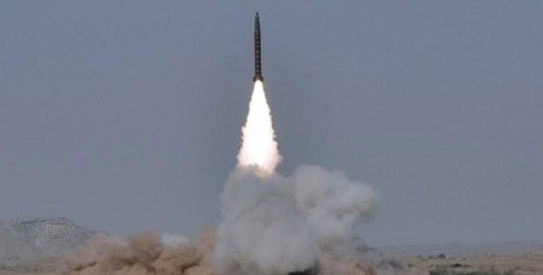
Capable of carrying nuclear warheads, the military said the special feature of Friday’s launch was the validation of a new multi-tube missile launch vehicle (MLV).
“The three tube MLV enhances manifold (times) the targeting and deployment options in the conventional and nuclear modes,” the military said.
Pakistan carried out nuclear tests in May 1998 just days after similar tests by its old rival India, Reuters reported.
The South Asian nations have fought three wars since independence in 1947.
They carry out missile tests regularly and Friday’s exercise was not expected to lead to any increase in tension between them.
Source - www.dawn.com
Rows between Europe’s leaders threatened to undermine attempts to rescue the eurozone as it emerged that a make-or-break summit will not address key aspects of the deepening crisis.
As Germany raised fresh objections to the proposed rescue deal for indebted eurozone countries, the International Monetary Fund signalled it was considering stepping in - a move that could lead to British taxpayers paying to support the single currency.Amid mounting Coalition tensions over Europe between the Conservatives and Liberal Democrats, David Cameron will today travel to Brussels, where European Union leaders have promised to hammer out a deal to resolve Europe’s debt crisis.But officials admitted last night that many of the details of any deal will not be resolved tonight and will have to wait for another meeting of EUfinance ministers at the weekend.The gloomy outlook worried financial markets. The FTSE 100 index closed down at 5525, and shares in Germany, France and the US all fell.The single currency rescue effort was left hanging in the balance last night as Germany and Italy both challenged aspects of the likely deal.EU leaders have said a summit tonight will outline plans to cut Greece’s crippling debt burden and expand a bail-out fund meant to support larger EU economies such as Italy and Spain.Yet leaders last night appeared to be little closer to settling their long-standing differences on those issues.The biggest row centres on the role of the European Central Bank in bailing out struggling eurozone economies.A draft agreement circulated among leaders yesterday suggested that the ECB should go on buying the bonds of troubled members, effectively lending money to them directly.The ECB’s bond-buying programme is unpopular in Germany, where critics fear it will compromise the central bank’s independence and its ability to control inflation.Angela Merkel, the German chancellor who is facing fierce domestic opposition to the rescue deal, yesterday publicly rejected the draft as “not acceptable to Germany”.The German parliament will today vote on a motion that would tell the ECB to stop its bond-buying programme.Meanwhile, there were fears that the Italian government of Silvio Berlusconi could collapse over a dispute about austerity measures demanded by other EU governments.In exchange for supporting Italy’s bonds, the EU has told Italy to increase its retirement age.The Northern League, Mr Berlusconi’s junior coalition partners, oppose the plan. The party’s leader, Umberto Bossi, yesterday suggested the government could fall over issue and said he was “pessimistic” about its survival.In Brussels, the European Commission insisted that Mr Berlusconi must do more to balance his country’s budget. Italy still needs to back up Mr Berlusconi’s promises with “specific actions” taken with “clear timing,” the commission said.The summit tonight is also intended to agree on ways to boost the financial power of bail-out funds meant to underwrite governments in Italy and Spain if they struggle to raise money on international markets. One option is a Special Investment Vehicle, a fund that raises money from investors including wealthy governments and the IMF.Eurozone attempts to cut the Greek debt burden also appeared to be making little progress, though the Greek government expressed hopes that the summit will announce that bond-holders will lose 50 per cent of their stakes.Sir Mervyn King, the Governor of the Bank of England, suggested the EU leaders’ emergency measures can buy time but cannot resolve the fundamental threats to European economic stability.Disclaimer: The views expressed in this article are the sole responsibility of the author and do not necessarily reflect those of the SPY EYES Analysis and or its affiliates. The contents of this article are of sole responsibility of the author(s). SPY EYES Analysis and or its affiliates will not be responsible or liable for any inaccurate or incorrect statements and or information contained in this article.
Source--- [ http://www.telegraph.co.uk/news/worldnews/europe/eu/8849346/Eurozone-debt-crisis-talks-break-down-as-Angela-Merkel-rejects-rescue-deal.html ]
Rows between Europe’s leaders threatened to undermine attempts to rescue the eurozone as it emerged that a make-or-break summit will not address key aspects of the deepening crisis.
As Germany raised fresh objections to the proposed rescue deal for indebted eurozone countries, the International Monetary Fund signalled it was considering stepping in - a move that could lead to British taxpayers paying to support the single currency.
Amid mounting Coalition tensions over Europe between the Conservatives and Liberal Democrats, David Cameron will today travel to Brussels, where European Union leaders have promised to hammer out a deal to resolve Europe’s debt crisis.
But officials admitted last night that many of the details of any deal will not be resolved tonight and will have to wait for another meeting of EUfinance ministers at the weekend.
The gloomy outlook worried financial markets. The FTSE 100 index closed down at 5525, and shares in Germany, France and the US all fell.
The single currency rescue effort was left hanging in the balance last night as Germany and Italy both challenged aspects of the likely deal.

1937, March, 2 Arabs killed on Bat-Yam beach. 1937, November 14 10 Arabs killed by Irgun units launching attacks around Jerusalem, ("Black Sunday")
- 1938, April 12 2 Arabs and 2 British policemen were killed by a bomb in a train in Haifa.1938, April 17 1 Arab was killed by a bomb detonated in a cafe in Haifa1938, May 17 1 Arab policeman was killed in an attack on a bus in the Jerusalem-Hebron road.1938, May 24 3 Arabs were shot and killed in Haifa.1938, June 23 2 Arabs were killed near Tel-Aviv.1938, June 26 7 Arabs were killed by a bomb in Jaffa.1938, June 27 1 Arab was killed in the yard of a hospital in Haifa.1938, June (late) Unspecified number of Arabs killed by a bomb that was thrown into a crowded Arab market place in Jerusalem.1938, July 5 7 Arabs were killed in several shooting attacks in Tel-Aviv.1938, July 5 3 Arabs were killed by a bomb detonated in a bus in Jerusalem.1938, July 5 1 Arab was killed in another attack in Jerusalem.1938, July 6 18 Arabs and 5 Jews were killed by two simultaneous bombs in the Arab melon market in Haifa.1938, July 8 4 Arabs were killed by a bomb in Jerusalem.1938, July 16 10 Arabs were killed by a bomb at a marketplace in Jerusalem.1938, July 25 43 Arabs were killed by a bomb at a marketplace in Haifa.1938, August 26 24 Arabs were killed by a bomb at a marketplace in Jaffa.1938, February 27 33 Arabs were killed in multiple attacks, incl. 24 by bomb in Arab market in Suk Quarter of Haifa and 4 by bomb in Arab vegetable market in Jerusalem.1939, May 29 5 Arabs were killed by a mine detonated at the Rex cinema in Jerusalem.1939, May 29 5 Arabs were shot and killed during a raid on the village of Biyar 'Adas.1939, June 2 5 Arabs were killed by a bomb at the Jaffa Gate in Jerusalem.1939, June 12 1 British bomb expert trying to defuse the bombs killed, during a post office in Jerusalem was bombing1939, June 16 6 Arabs were killed in several attacks in Jerusalem.1939, June 19 20 Arabs were killed by explosives mounted on a donkey at a marketplace in Haifa.1939, June 29 13 Arabs were killed in several shooting attacks around Jaffa during a one-hour period.1939, June 30 1 Arab was killed at a marketplace in Jerusalem.1939, June 30 2 Arabs were shot and killed in Lifta.1939, July 3 1 Arab was killed by a bomb at a marketplace in Haifa.1939, July 4 2 Arabs were killed in two attacks in Jerusalem.1939, July 20 1 Arab was killed at a train station in Jaffa.1939, July 20 6 Arabs were killed in several attacks in Tel-Aviv.1939, July 20 3 Arabs were killed in Rehovot.1939, August 27 2 British officers were killed by a mine in Jerusalem.1944, September 27 Unknown number of casualties, around 150 Irgun members attacked four British police stations1944, September 29 1 Senior British police officer of the Criminal Intelligence Department assassinated in Jerusalem.1945, November 1 5 locomotives destroyed in Lydda station. Two staff, one soldier and one policeman killed.1945, December 27 3 British policemen and 4 Basuto soldiers killed during the bombing of British CID headquarters in Jerusalem; 1 British soldier killed during attack of British army camp in north Tel Aviv1946, February 22 Destroyed 14 aeroplanes at 5 RAF stations.1946, July 22 91 people were killed at King David Hotel Bombing mostly civilians, staff of the hotel or Secretariat,41 Palestinian Arabs, 15-28 British citizens, 17 Palestinian Jews, 2 Armenians, 1 Russian, 1 Greek and 1 Egyptian.1946, October 30 2 British guards killed during Gunfire and explosion at Jerusalem Railway Station.1946, October 31 Bombing of the British Embassy in Rome. Nearly half the building was destroyed and 3 people were injured.1947, January 12 4 killed in bombing of British headquarters.1947, March 1 17 British officers killed, during raid and explosion.1947, March 12 1 British soldier killed during the attack on Schneller Camp.1947, July 29 2 kidnapped British sergeants hanged.1947, September 26 4 British policemen killed in Irgun bank robbery.1947, September 29 13 killed, 53 wounded in attack on British police station.1947, December 11 13 killed in attack on Tireh, near Haifa1947, December 12 20 killed, 5 wounded by barrel bomb at Damascus Gate.1947, December 13 6 killed, 25 wounded by bombs outside Alhambra Cinema.1947, December 13 5 killed, 47 wounded by two bombs at Damascus Gate.1947, December 13 7 killed, 10 seriously injured in attack on Yehudieh.1947, December 16(ca) 10 killed by bomb at Noga Cinema in Jaffa.1947, December 20 6 Arabs killed, dozens wounded by bomb at Haifa refinery, precipitating the Haifa Oil Refinery massacre, which lead to the Balad al-Shaykh massacre.1947, December 29 14 Arabs killed by bomb in Jerusalem.1948, January 1 2 Arabs killed and 9 injured by shooting attack on cafe in Jaffa.1948, January 5 14 Arabs killed and 19 injured by truck bomb outside the 3-storey 'Serrani', Jaffa's built Ottoman Town Hall1948, January 7 20 Arabs killed by bomb at Jaffa Gate.1948, February 10 7 Arabs killed near Ras el Ain after selling cows in Tel Aviv1948, February 18 12 Arabs killed and 43 wounded at a marketplace in Ramla1948, March 1 20 Britons killed and 30 wounded in the Bevingrad Officers Club bombing1948, April 9-April 11 107-120 Palestinians killed and massacred (the estimate generally accepted by scholars, instead the first announced number of 254) during and after the battle at the village of Deir Yassin near Jerusalem, by 132 Irgun and 60 Lehi fighters.1948, April 6 7 British soldiers, including Commanding Officer, killed during an arms raid on Pardes Hanna Army camp.Between 1937-1948 During 11 years of attacks, Hundreds of Arab civilians, over 20 British officers and over 20 Jewish civilians were killed in total by the Irgun

And, finally, Muslims are nowhere near the greatest terrorist threat. According to Europol, between 2006 and 2008 only .4 percent of terrorist plots (including attempts and fully executed attacks) in Europe were from Islamists. The lion’s share (85 percent) were related to separatism.
By Gary Younge
Two weeks after the fatal terrorist attacks of July 7, 2005, in London, and one day after another failed attack, a student, Jean Charles de Menezes, was in the London Underground when plainclothes police officers gave chase and shot him seven times in the head.
Initial eyewitness reports said he was wearing a suspiciously large puffa jacket on a hot day and had vaulted the barriers and run when asked to stop. Anthony Larkin, who was on the train, said he saw “this guy who appeared to have a bomb belt and wires coming out.” Mark Whitby, who was also at the station, thought he saw a Pakistani terrorist being chased and gunned down by plainclothes policemen. Less than a month later, Whitby said, “I now believe that I could have been looking at the surveillance officer” being thrown out of the way as Menezes was being killed.
The Pakistani turned out to be a Brazilian. Security cameras showed he was wearing a light denim jacket and clearly in no rush as he picked up a free paper and swiped his metrocard.
“The way we see things is affected by what we know and what we believe,” wrote John Berger inWays of Seeing. “The relation between what we see and what we know is never settled.”
When some Western commentators see a terrorist attack they are apparently far more comfortable with what they believe than what they know.
So it was on Friday when news emerged of the appalling attacks in Norway that have left an estimated seventy-six dead and a nation traumatized. Rupert Murdoch’s Sun in Britain (the bestselling daily newspaper) ran with the headline “Al Qaeda massacre: Norway’s 9/11.” The Weekly Standard insisted: “We don’t know if al Qaeda was directly responsible for today’s events, but in all likelihood the attack was launched by part of the jihadist hydra.” Jennifer Rubin at the Washington Post then claimed: “This is a sobering reminder for those who think it’s too expensive to wage a war against jihadists.”
In just a few hours an entire conceptual framework had been erected—though hardly from scratch—to discuss the problem of Muslims in particular and non-white immigration in Europe in general and the existential threat these problems pose to civilization as we know it.
Then came the fact that the terrorist was actually a white, Christian extremist and a neo-Nazi, Anders Breivik, raging against Islam and multiculturalism. Unlike Muslims in the wake of Islamist attacks, Christians weren’t called upon to insist upon their moderation. No one argued that white people had to get with the Enlightenment project. But the bombings—and the presumptions about who was responsible—suggest that the true threat to European democracy is not Islam or Muslims but, once again, fascism and racists.
The belief that Muslims must have been involved chimes easily with a distorted, hysterical understanding of the demographic, religious and racial dynamics that have been present in Europe for well over a generation, variants of which are also at work in the United States today.
The general framing goes like this. Europe is being overrun by Muslims and other non-white immigrants, who are outbreeding non-Muslims at a terrifying rate. Unwilling to integrate culturally and unable to compete intellectually, Muslim populations have become hotbeds of terrorist sympathy and activity. Their presence threatens not only security but the liberal consensus regarding women’s rights and gay rights that Western Europe has so painstakingly established; and overall, this state of affairs represents a fracturing of society that is losing its common values. This has been allowed to happen in the name of not offending specific ethnic groups, otherwise known as multiculturalism.
One could spend all day ripping these arguments to shreds, but for now let’s just deal with the facts.
There have been predictions that the Muslim population of Europe will almost double by 2015 (Oner Taspiner, the Brookings Institution); double by 2020 (Don Melvin, the Associated Press); and be 20 percent of the continent by 2050 (Esther Pan, Council on Foreign Relations). Republican presidential hopeful Rick Santorum told Sarah Posner of Religion Dispatches: “The number I heard is every 32 years the population, the European population of Europe will be reduced by 50 percent. That’s how bad their birthrates are. This is in many respects a dying continent from the standpoint of European-Europeans.”
This is nonsense. The projections are way off. While Muslims in Europe do have higher birthrates than non-Muslims, their birthrates are falling. A Pew Forum study, published in January 2011, forecast an increase of Muslims in European population from 6 percent in 2010 to 8 percent in 2030.
The Norwegian terrorist Breivik feared a Muslim takeover. But Muslims make up 3 percent of Norway. Black Americans have a greater presence in Alaska.
But even if these predictions were true, so what? There’s nothing to say Europe has to remain Christian or majority-white.
Nor do immigrants struggle to integrate. In Britain, Asian Muslims, Sikhs and Hindus all marry outside of their own groups at the same rates as whites. For most ethnic minorities in Britain, roughly half or more of their friends are white. Only 20 percent of those born in Britain have friends only from their own group. According to a Pew Research Center survey, the principal concerns of Muslims in France, Germany and Spain are unemployment and Islamic extremism.
In most of Europe the official politics of multiculturalism that the likes of Breivik and more mainstream politicians rail against—a liberal, state-led policy of encouraging and supporting cultural difference at the expense of national cohesion—is an absolute fiction. Last year German chancellor Angela Merkel claimed the “multikulti” experiment had failed. Earlier this year, British Prime Minister David Cameron said the same thing. The truth is that neither country ever tried such an experiment. “We never had a policy of multiculturalism,” explains Mekonnen Mesghena, head of migration and intercultural management at the Heinrich Böll Foundation. “We had a policy of denial: denial of immigration and of diversity. Now it’s like we are waking up from a long trance.”
The real object of their ire is the existence of “other”—meaning non-white—cultures and races in Europe: the fact of “other” cultures, not the promotion of them. The single greatest obstacle to integration in most of Europe is not Islam or multiculturalism but racism and the economic and academic disadvantage that comes with it.
And, finally, Muslims are nowhere near the greatest terrorist threat. According to Europol, between 2006 and 2008 only .4 percent of terrorist plots (including attempts and fully executed attacks) in Europe were from Islamists. The lion’s share (85 percent) were related to separatism. That doesn’t mean there isn’t a problem. But it’s not on the scale or of the nature that those first out of the gate on Friday claimed it was. Put bluntly, if you have to assume anything when a bomb goes off in Europe, think region, not religion.
But there are some in Europe who are struggling to cope with the changes taking place—who are failing to integrate into changing societies and who harbor deep-seated resentments against their fellow citizens. That is a sizeable and growing section of the white population so alienated that it has once again made fascism a mainstream ideology on the continent.
In Germany the bestselling book since the Second World War by former Bundesbank board member Thilo Sarrazin blames inbreeding among Turks and Kurds for “congenital disabilities” and argues that immigrants from the Middle East are a “genetic minus” for the country. “But the subject is usually hushed up,” he wrote. “Perish the thought that genetic factors could be partially responsible for the failure of parts of the Turkish populations in the German school system.”
A poll published in the national magazine Focus in September 2010 showed 31 percent of respondents agreeing that Germany is “becoming dumber” because of immigrants; 62 percent said Sarrazin’s comments were “justified.” In Austria, Belgium, Denmark, France and Italy, hard-right nationalist and anti-immigrant parties regularly receive more than 10 percent of the vote. In Finland it is 19 percent; in Norway it is 22 percent; in Switzerland, 29 percent. In Italy and Austria they have been in government; in Switzerland, where the anti-immigrant Swiss People’s Party is the largest party, they still are.
Breivik was from a particularly vile strain of that trend. But he did not come from nowhere. And the anxieties that produced him are growing. Fascists prey on economic deprivation and uncertainty, democratic deficits cause by European Union membership and issues of sovereignty related to globalization. Far right forces in Greece, for example, are currently enjoying a vigorous revival. When scapegoats are needed they provide them. When solutions are demanded they are scarce.


 Posts
Posts

