Showing posts with label tacstrat. Show all posts
Showing posts with label tacstrat. Show all posts
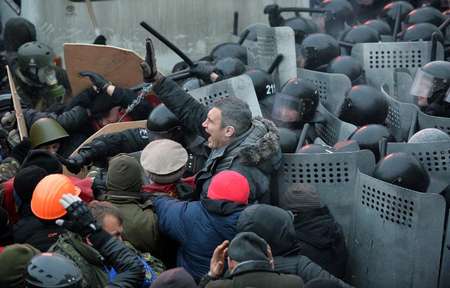
Viktor F. Yanukovych of Ukraine and the Ukrainian opposition leaders signed an agreement on Friday that ended the deadly protests in Kiev by promising a new constitution and early elections. But the Russian president’s envoy to Kiev refused to co-sign it. While Moscow welcomed an end to the violence, it basically viewed the agreement as a diktat by the Western-backed Ukrainian opposition. The opposition has seized power in Kiev, and Moscow is wary that the crisis will not end anytime soon. Some radical groups remain well-armed; there are deep political, cultural and regional cleavages in Ukrainian society; the country’s elites are in disarray; and its economic situation is rapidly deteriorating. The mess is very much Ukraine’s own, and Russia has far less influence on it than is commonly appreciated.
The most popular myth about Moscow’s role in the Ukrainian crisis is that Mr. Yanukovych has been but a puppet of President Vladimir V. Putin. In reality, Mr. Putin has been very frustrated with his Ukrainian counterpart. To Mr. Putin, Mr. Yanukovych is unreliable, forever vacillating between the European Union and Russia; and now, a totally spent force, he has fled from Kiev to Kharkiv, a Russian-speaking city in eastern Ukraine. Moscow knows that the Ukrainian oligarchs, most of whom used to support Mr. Yanukovych, are largely anti-Russian. Though they in effect rule Ukraine, they fear being taken over by the richer business giants next door. Even those who made their money in Russia, like the protest-funder Petro Poroshenko, prefer to keep it in the West.
The protests erupted when Mr. Yanukovych refused to sign the so-called association agreement between Ukraine and the European Union, which would have established a free-trade area, among other things. Despite what he claims, it wasn’t the Kremlin that made him do that. Moscow had clearly signaled it did not want Kiev to sign the deal when it introduced de facto sanctions on Ukrainian products last year, but ultimately Mr. Yanukovych was guided by his own calculations, rather than Putin’s admonitions or advice. The fundamental reason Mr. Yanukovych demurred was fear that he would not be re-elected in 2015 if he signed the agreement. At some point he realized that the deal would bring no financial support from the European Union and saw no way to offset the inevitable drop in trade with Russia or cushion the blow to Ukraine’s Soviet-era heavy industry.
During the months of standoffs in Kiev, Russia’s actual role was much more modest than advertised by the international media or the rumor mill in Kiev. The Russian ambassador to Ukraine, Mikhail Zurabov, was conspicuously absent from public view. The Kremlin ordered all Duma members to stay out of Ukraine. Dmitry Rogozin, a deputy prime minister and a former Russian ambassador to NATO with a knack for making in-your-face comments about the West, has largely remained silent on Ukraine. The only Russian official to display any continuous interest in Ukraine was Sergey Glazyev, Putin’s adviser for Eurasian integration, who spoke at conferences and wrote articles about the high costs of Ukraine’s turn to the European Union.
Mr. Putin did receive Yanukovych several times, in Sochi and Moscow. And in December Russia did offer to buy $15 billion in Ukrainian-government bonds — dwarfing any conditional aid the European Union could cough up via the International Monetary Fund — and lower by one-third the price of its gas shipments to Ukraine. This financial support was extended without any strings attached, with the dual purpose of helping Ukraine avoid a likely default and building goodwill for closer economic relations in the future.
But it was a risky proposition, given the political uncertainties in Kiev. And the move may be ineffectual. Moscow’s gesture of support was built on the belief, which Mr. Putin himself has expressed, that Ukrainians and Russians are one people. This obviously is not true, if only because Ukrainians themselves are not — at least not yet — one people. Just compare Lviv and Sebastopol: Western Ukraine, which was annexed by the Soviet Union only under Stalin, is vehemently anti-Russian; the east and the south are Russophone, with the Crimea mostly Russian ethnically. To the vast majority of the elite in Ukraine, the country’s independence from the Soviet Union meant, above all, independence from Russia. There are virtually no Ukrainian politicians who can be called pro-Russian: This simply goes against the grain of Ukraine’s national idea.
Thus Mr. Putin’s offer that Ukraine and Russia forge closer economic integration by way of a customs union are not very compelling to many Ukrainians. The idea also is potentially hazardous for Russia. Under that scheme, Moscow would need to pump a lot more money into Ukraine and give it a large say in joint bodies such as the Eurasian Economic Commission, with little guarantee that Ukraine wouldn’t break away again once it recovered from its current financial crunch.
Ukraine’s “February Revolution” may be a blessing in disguise for Moscow, as it could help debunk the notion that Russia cannot be a great power without Ukraine as its junior partner. Moscow does not need to govern more people; it needs to raise the health, education and work standards in its own people’s lives.
Despite what some Ukrainians suspect, Moscow is unlikely to try bringing about the breakup of Ukraine in order to annex its southern and eastern parts. That would mean civil war next door, and Russia abhors the idea. Moscow’s best option at this point is to stand back and wait, while quietly favoring decentralization in Ukraine. Although federalization is seen in Kiev and western Ukraine as a step toward ultimate partition, it could in fact help hold Ukraine together. With more financial and cultural autonomy, the country’s diverse regions could more easily live and let live, and keep one another in check. Promoting decentralization in Ukraine would be a realistic long-term strategy for Russia, something Moscow has lacked so far.


Two congressmen, Peter Roskam and Dan Lipinski – a Republican and Democrat respectively, both from the state of Illinois – have introduced a bill that would strip American academic institutions of federal funding if they choose to boycott Israel.
The move follows a growing international movement to protest the Israeli occupation and violations of Palestinian human rights. The most recent to join the boycott is the American Studies Association (ASA), a group composed of about 5,000 academics and scholars dedicated to the study of American culture.
The ASA boycott is part of a larger movement called Boycott, Divestment, and Sanctions (BDS), which wants to pressure Israel to change its policies in the occupied Palestinian territories by isolating the country. Opponents of BDS say the movement – which calls for Palestinian refugees’ right to return – is an attempt to delegitimise Israel and dilute its majority-Jewish population.
Last week, BDS called on the Rolling Stones to cancel concerts planned in Israel this coming summer. The movement also played a role in the recent decision of Dutch pension fund PGGM, which oversees about $200bn in assets, to withdraw money from five Israeli banks.
“Given the day-to-day reality and domestic legal framework they operate in, the banks have limited to no possibilities to end their involvement in the financing of settlements in the occupied Palestinian territories,” the fund said in a statement.
Other organisations participating in the boycott include the Association for Asian-American Studies, the 100,000-member Federation of French-Speaking Belgian Students, and the Teachers Union of Ireland.
Diplomatic kerfuffle
The boycotts recently sparked a diplomatic row between the United States and Israel. Speaking at the Munich Security Conference earlier this month, US Secretary of State John Kerry said that allowing peace talks between Israel and the Palestinians to fail would give fodder to critics of Israel, including those in the BDS movement.
“You see, for Israel there’s an increasing de-legitimisation campaign that has been building up. People are very sensitive to it. There is talk of boycotts and other kinds of things,” Kerry said. “Today’s status quo absolutely, to a certainty, I promise you 100 percent, cannot be maintained. It’s not sustainable. It’s illusionary. There’s a momentary prosperity, there’s a momentary peace.”
Israel quickly fired back, with Economy Minister Naftali Bennett blasting Kerry for linking peace and economic sanctions. Israeli Prime Minister Benjamin Netanyahu added, “No pressure will force me to give up the vital interests of the state of Israel, above all the security of the citizens of Israel”.
This prompted US State Department spokeswoman Jen Psaki to respond, “Secretary Kerry has always expected opposition and difficult moments in the process, but he also expects all parties to accurately portray his record and statements”.
First Amendment issues
The Protect Academic Freedom Act, introduced by Roskam and Lipinski in early February, marks the first time Congress has tried to create penalties for higher learning institutions that receive government money and boycott Israel. It follows similar efforts at the state level in Maryland and New York.
“These organisations are clearly free to do what they want to do under the [US Constitution's] First Amendment,” Roskam said on the House floor while introducing the bill. “But the American taxpayer doesn’t have to subsidise it. The American taxpayer doesn’t have to be complicit in it. And the American taxpayer doesn’t have to play any part in it.”
The bill has already received support from prominent Israeli backers, including Michael Oren, the former Israeli ambassador to the US. “The Protect Academic Freedom Act represents the first legislation that defends Israel against discriminatory boycotts which impede rather than advance the peace process and that seek to deny Israelis the right to free speech on American campuses,” Oren said in a statement released by Roskam’s office.
The Simon Wiesenthal Center and Christians United for Israel have also backed the bill. “Generally speaking, we like to keep the government out of any issues that have to do to with speech,” said Rabbi Abraham Cooper, associate dean of the Simon Wiesenthal Center. “But institutions that boycott Israel, they certainly should not in any way be subsidised from the public domain.”
He likened doing nothing to prevent institutions from boycotting Israel to “a young arsonist that gets caught with matches by his parents and gets a slap on the wrist”.
While it’s not clear whether the bill would receive broader backing in Congress, 134 US lawmakers have written a letter to ASA condemning the boycott. “While ASA has every right to express its views on policies pursued by any nation or government,” reads the letter, “we believe that the decision to blacklist Israeli academic institutions for Israeli government policies with which ASA disagrees demonstrates a blatant disregard for academic freedom”.
Notably, major US Jewish groups such as AIPAC and the Anti-Defamation League have not backed the bill – perhaps due to concerns that if it became law, it would violate the US constitution’s First Amendment, which guarantees freedom of speech. Abe Foxman, the director of the Anti-Defamation League, said his group is “not sure that this bill would be the most effective means of recourse”.
Opposition
Dima Khalidi, director of Palestine Solidarity Legal Support, said she was opposed to the bill. “This legislation is one of the many ways that the government and various pro-Israel organisations are trying to suppress efforts to change the status quo in Israel/Palestine and in US policy towards Israel. For legislators to punish universities for the speech activities of an academic organisation because of their disagreement with the political viewpoint it expresses is offensive to First Amendment principles.”
Khalidi noted that the Supreme Court has ruled that advocating boycotts to spur political, social and economic change are protected under the First Amendment.
In New York, a group consisting of dozens of Columbia University professors, the New York State United Teachers union, CCR and the New York Civil Liberties Union have also come out to publicly oppose similar legislation at the state level.
The original New York bill targeting academic institutions that boycott Israel was killed last month after protests. However, it has been re-introduced with lighter penalties for schools. In Maryland, a similar bill has drawn 50 co-sponsors, and lawmakers in Illinois are expected to introduce their own version this week.

The Taliban Shura has finalised a fifteen point draft for negotiations with the Pakistan government and the draft proposal is likely to be handed over to the peace facilitators and their representatives who are in Waziristan, sources said.
The Taliban Shura had been meeting since Saturday under its deputy Ameer Sheikh Khalid Haqqani.
Professor Ibrahim Khan and Maulana Yousuf Shah who are in Waziristan for a meeting with the Taliban Shura are likely to convey these points to the committee formed by the government for mediation.
The points are:
• Stop drone attacks
• Introduce Sharia law in courts
• Introduce Islamic system of education in both public and private educational institutions
• Free Pakistani and foreign Taliban captured in jails
• Restoration and remuneration for damage to property during drone attacks
• Hand over control of tribal areas to local forces
• Withdrawal of army from tribal areas and close down check posts
• All criminal allegations held against the Taliban to be dropped
• Prisoners from both sides to be released
• Equal rights for all, poor and rich
• Families of drone attack victims to be offered jobs
• End interest based banking system
• Stop supporting the US on the war on terror
• Replace the democratic system of governance with Islamic system
• Break all relations with the US

National Security Adviser Sartaj Aziz, who met US Defence Secretary Chuck Hagel on Tuesday, has said that only a regional approach of total non-interference can bring peace and stability to Afghanistan.
At his meeting with Secretary Hagel and Chairman Joint Chiefs of Staff General Martin Dempsey, Mr Aziz also “underscored Pakistan’s commitment to… facilitating US drawdown from Afghanistan”, said an official statement.
Earlier, Mr Aziz conceded that the US plan to withdraw most of its troops from Afghanistan by the end of this year would create a vacuum in Afghanistan, but warned that this “vacuum should only be filled by Afghans, not outsiders”.
At the Pentagon meeting, Mr Aziz said that “a forward looking, broad-based and enduring defence partnership between Pakistan and the US is critical for security and stability in the region”.
The adviser, who is visiting Washington for the US-Pakistan Strategic Dialogue, also said that Pakistan would not “pressurise Afghanistan” to sign a security agreement with the United States.
Mr Aziz said that while experts felt the proposed security agreement would help stabilise Afghanistan, Pakistan believed that “it’s for the Afghans to decide whether they want to do this deal”.
He said that Pakistan and the US were also working on a framework for defence reimbursement after 2014 when the United States plans to pull most of its combat troops from Afghanistan.
US officials will present their reimbursement proposals at a joint meeting in February, Mr Aziz said.
He visited the Pentagon with Defence Minister Khawaja Muhammad Asif, Ambassador Jalil Abbas Jilani, Secretary Defence Asif Yasin Malik and Chief of the General Staff Lt-Gen Ishfaq Nadeem Ahmad.
The meeting focused on security cooperation and identified key priorities for the strengthening the defence partnership in the future.
Mr Aziz noted that positive momentum in defence exchanges over the last one year had helped both sides make significant progress in a number of areas such as supply routes, counter-IEDs cooperation and counter-terrorism.
Talking to journalists, Mr Aziz said there could be no peace in Afghanistan unless all countries of the region followed the same policy of non-interference and “have no favourites in that country”.

Even with all the optimism about the global economy here last week at the annual meeting of the World Economic Forum, there was a remarkable economic and political risk that appeared to have been largely overlooked: The long-simmering battle between China and Japan may be close to boiling over. One top executive went so far as to describe the nations’ relationship as a “stealth war.”
The implications for the global economy — and some of the largest multinational companies — are profound. China and Japan represent the second- and third-largest economies in the world, after the United States, and they are among each other’s largest trade partners. General Motors,Microsoft, Boeing, Nike, Coca-Cola and Procter & Gamble, among others, have huge businesses in both countries.
“I probably spoke to no less than 40 U.S. C.E.O.’s here and I would say this issue came up in more than half of those conversations,” said Ian Bremmer, the political scientist who founded the Eurasia Group, the political risk consulting firm. “This week at Davos, for me, the big takeaway was that China-Japan was much more problematic than we thought. The possibility that you get anti-Japanese sentiment in a big way and it causes real disruption on trades and hurting both economies is real.”
If you need evidence of the significance of this geopolitical clash, look no further than the surprising comment made here by Prime Minister Shinzo Abe of Japan, who said his country’s relationship with China was in a “similar situation” to the one between Germany and Britain before World War I.
Mr. Abe was trumped by Wu Xinbo, a Chinese university dean who is considered close to China’s leadership, when he described Mr. Abe as a “troublemaker” and, at one point, compared him, somewhat obliquely, toKim Jong-un, the North Korean dictator.
“I have to say that the political trust between the two countries now is very low,” Mr. Wu said, suggesting that he expects “political relations between our two countries will stay very cool, even frozen, for the remaining years of the Abe administration in Japan.”
Problems between China and Japan have long been festering, especially as Mr. Abe has sought to rewrite the country’s Constitution and build the country’s military, which has long been considered only defensive.
Tensions rose when China angered Japan last November when it claimed an air defense identification zone over a chain of islands in the East China Sea that the countries have disputed claims over. The conflict increased after Mr. Abe visited the Yasukuni Shrine, where Japanese war dead are commemorated, including several war criminals who were executed after Japan’s defeat in World War II. The trip offended many Chinese, and the Obama administration had warned Mr. Abe not to visit the shrine.
China-Japan political relations have been strained since the end of World War II. Previous visits by Japanese politicians have angered China and South Korea, which both suffered greatly under Japan’s empire-building efforts then. And the Japanese citizenry has often sought to distance itself from its imperialist past, preferring instead to highlight the nation’s economic progress and prowess.
Yet now, the intensity of the feelings of mutual distrust is striking. According to Pew Research, just 1 in 20 Japanese “have a favorable attitude toward China” and “anti-Japan sentiment is quite strong in China, where 90 percent of the public has an unfavorable opinion of Japan.”
The latest tensions are having a direct economic impact; the Japanese, for example, are investing less in China.
Mr. Bremmer, of the Eurasia Group, put it bluntly: “The Chinese have written off Shinzo Abe as someone they can potentially work with. They mistrust him completely. They believe he is belligerent toward them and believe an escalatory policy is the appropriate one to pursue.”
After Mr. Abe made his comment comparing his country’s relationship as being similar to Britain and Germany in 1914, when the two countries were major trading partners, China’s leaders made their own attacks. “Rather than using pre-World War I Anglo-German relations, why don’t you deeply examine your mistakes during the First Sino-Japanese War, the Japanese colonial rule of the Korean Peninsula and the fascist war that Japan launched on victim countries in World War II?” Qin Gang, a spokesman for China’s foreign ministry, asked of Mr. Abe.
Mr. Abe, in fairness, did try to play down any hints that the simmering tensions would lead to a prolonged military conflict.
“Japan has sworn an oath to never again wage a war,” Mr. Abe said in his speech. “We have never stopped, and will continue to be wishing for the world to be at peace.”
But that’s not what many of the executives and regulators I spoke to after his presentation took away from his comments. “I’m going to be asking our teams in China and Japan to do a full analysis of the risks to our business when I get home,” one Fortune 500 C.E.O. told me, seeming anxious. “Maybe this should have been on my radar before, but it is now.”
So what’s the biggest risk?
“The possibility of a mistake where someone gets killed is going up,” Mr. Bremmer said. “They are scrambling their fighters in the East China Sea every day.”
And the misunderstandings could deepen. “More problematically, the aftermath of a mistake will have both countries actively mistrusting the intentions of each other without a mechanism to really talk to each other and without the Americans acting as an interlocutor,” Mr. Bremmer said.
Mr. Wu said that the possibility of war was overstating the case: “China doesn’t want to fight a war.”
One of the greatest challenges multinational companies doing business in the region may face is that the United States government may not be positioned to step into the middle of the debate. Many of the American officials who were closest to Japan have left the Obama administration. Hillary Rodham Clinton, Kurt Campbell and Tom Donilon — all known for being the architects of President Obama’s “pivot” toward Asia — are no longer there, nor is Timothy F. Geithner, who worked in Japan in the 1990s and had close relationships with many senior leaders.
“Kerry doesn’t really do Asia,” Mr. Bremmer said about Secretary of StateJohn Kerry, who would most likely take umbrage at that assertion. “Susan Rice? No,” he said of the United States ambassador to the United Nations.
“Who is paying attention to foreign policy in Obama-land or in Congress? Nobody.” Whether that is true or not, it is clear that China, long seen as a fast-growing economy, and Japan, which has experienced a rebound in the last year, now should be added to the list of political and economic risks that businesses should consider in 2014.

Iran and six world powers have reached an interim agreement: Iran will halt and reverse some elements of its nuclear programme for six months in return for moderate relief from the economic sanctions that have isolated the Islamic Republic.
Many hope the agreement marks a first step towards detente. It was widely hailed as “historic” and Iran’s Supreme Leader Ayatollah Ali Khamenei supported it. But opposition to the deal, notably from Israel’s Prime Minister Benjamin Netanyahu who dubbed it a “historic mistake” and dissenting US Congress voices, came just as swiftly.
As negotiations continue over six months to reach a comprehensive agreement, Empire tracks how Iran-US relations became mired in ideological hostility and the more recent diplomatic impasse over suspicion – at times alarmist – that Iran has been covertly working on a nuclear bomb, while Tehran insists its nuclear energy ambitions are peaceful. As sanctions on Iran have increased, so too have the technical capabilities of the country’s nuclear programme.
In this episode, Empire looks more deeply into the particularities of the Iran-US relationship, what the recent agreement signifies, the response from the Arab world, and we ask whether such a deal has the potential to reshape the Middle East. To understand the complexities and what lies ahead, we turn to the most illuminating voices, experts and key players in the US and in the Middle East.
We speak to Seyed Hossein Mousavian, an Iranian policymaker and scholar who had a front row seat at the 2003-2005 nuclear programme negotiations as Iran’s spokesman, about sanctions and the US’ changed stance on Iran.
To contextualise the deal, the opposition and to discuss if there is a shift in US foreign policy, we hear from Peter Beinart, a political writer for The Daily Beast and CUNY associate professor; Reza Marashi, the director of research at the National Iranian American Council; Barbara Slavin, a Washington DC correspondent for Al-Monitor and author of Bitter Friends, Bosom Enemies: Iran, the US and the Twisted Path to Confrontation (2007) and US diplomat Chas Freeman, who served as ambassador to Saudi Arabia during Desert Shield and Desert Storm.
We go on to unpack the geopolitical implications of the deal and in Washington, DC, we speak to Haleh Esfandiari, an academic and the Middle East Program director at the Woodrow Wilson Center for Scholars.
In Tehran, we talk to Payam Fazlinejad, a writer for the leading conservative newspaper, Kayhan, and Emad Abshenass, a political analyst and former managing director of Iran Daily newspaper.
We then head to Doha where we are joined by academic Hamid Dabashi, Hagop Kevorkian professor of Iranian Studies and Comparative Literature at Columbia University; Mahjoob Zweiri, an expert on Iran’s politics and the head of the Department of Humanities at the University of Qatar; and Dr. Marwan Kabalan, a Syrian academic, writer and former Dean of the Faculty of International Relations and Diplomacy at Damascus’ Kalamoon University.
Our panelists discuss the reactions and power dynamics in Iran; how this deal could lead to a redistribution of regional power and at what price; the concerns of the Arab world; and the true utility of the Iranian nuclear programme.
As we examine the agreement and its ramifications through Iran and the US: Diplomatic enrichment, Empireuncovers the complexities and big questions that lie ahead.
HOW quickly the need to cut deficits is reducing the European Union’s military ambitions. When EU leaders held a summit to discuss defence five years ago there was heady talk of being able to deploy 60,000 troops within 60 days. Today the objective is to get overstretched troops home from Afghanistan as budgets are cut. The EU is meant to have two “battle groups” of 1,500 men apiece ready to deploy at short notice, but it can barely muster one—and none has ever been used.
Pressure to make better use of dwindling resources is pushing governments to share costs and pool equipment. At this week’s summit, leaders will bless plans to develop a European drone to follow the likes of America’s Predator and Reaper. The European version would be an unarmed surveillance system that, unlike military drones, is intended to fly in civilian airspace. Predictably, the plan has caused alarmist talk in Britain about Brussels building a “European air force”, prompting officials to redouble their effort to remove ambiguities from turgid EU texts.
Yet the truly alarming prospect is that Europe is demilitarising so fast. Forget about euro-troops crying “Banzai!” Worry instead that the endless pruning of brigades, tanks, ships and jets will reduce even the largest European armed forces into small “bonsai armies”, says Christian Mölling of the Stiftung Wissenschaft und Politik, a German think-tank. When European countries led by France and Britain conducted air strikes in Libya in 2011, America had to provide essential help, including drones, air-to-air refuelling, stocks of smart bombs and headquarters staff. Europe has far more soldiers than America, but can send far fewer abroad.
In Mali, and now in the Central African Republic, France has intervened alone, but it wants support from European allies: if not soldiers, trainers for African troops; if not trainers, at least some money. Now France knows how America feels in NATO when it demands more military burden-sharing from allies and chafes at free-riders. Where France was always the chief troublemaker in NATO, in the EU Britain leads the awkward squad.
The problem for EU defence policy, says Daniel Keohane of Fride, a Spanish think-tank, is that “Germany does not want to use military force, Britain does not want to use the EU, and France is caught in the middle.” In 2011 Britain vetoed plans for an EU operational headquarters, annoying not only France but also Poland. Within NATO, France contributed more forces than Britain to the Steadfast Jazz exercise in Poland and Latvia in November. Russia’s decision to put Iskander missiles in Kaliningrad confirms that threats have not gone away.
The theology of European defence is maddening. NATO and the EU are both based in Brussels but can barely speak to each other officially, largely because of the chronic dispute between Turkey (in NATO but not the EU) and Cyprus (in the EU but not NATO). A bigger problem is the growing shortage of resources. Overall defence spending in Europe now stands at about 1.5% of GDP, well below the NATO target of 2%. Worse, defence has shrunk as a share of public spending, it being easier to demobilise soldiers than sack teachers. Worse still, Europe gets little bang despite spending nearly €200 billion ($275 billion) a year on defence. Money is squandered among the myriad armies, navies, air forces and headquarters at national level.
A recent study by the Centre for European Policy Studies, a think-tank in Brussels, makes the point eloquently. Europe has nine kinds of fighters and ground-attack planes, compared with America’s four. It sails 16 different frigates compared with just one American type. Europe’s defence industry is also crying out for consolidation. As defence spending falls, even the most competitive firms are in trouble. EADS, the Franco-German aerospace consortium, has announced plans to cut 5,800 jobs in France, Germany and Spain because of shrinking defence contracts. Its attempt to merge with Britain’s BAE Systems was blocked in October 2012, because of German politics.
The state of the industry is one reason why the EU is waking up to the problem. The European Commission, the EU’s civil service, sees defence firms as important providers of jobs and high-end manufacturing. Some of its research-and-development funds are likely to be directed to “dual-use” technology. The same drones used to watch out for migrants at sea or fires on land can help armies look for the enemy in foreign wars.
Uncle Sam needs EU
For all of Europe’s shortcomings, it remains the first port of call when the United States needs military help. The EU does much useful smaller-scale work, combining military power with civilian assistance, for instance in and around Somalia to deal with piracy. But if Europe wants to remain a security provider, it must retain the ability to deploy force. That means more European collaboration, not less. Yet a problem with pooling and sharing is that economies of scale are often offset by the extra cost and complexity that adding countries to a procurement project can create. Another is the fear of mutual dependence: martial countries worry that they will be stopped from taking action by an ally that controls a vital capability; more pacific states fear being dragged into somebody else’s war.
Collaboration works best among countries of similar outlook and ambitions. France and Britain have gone furthest in merging capabilities. The Nordics and the Benelux countries have also embarked on some joint projects. But as the African interventions show, there will be times when one country wants to go it alone. Military co-operation is the obvious answer. But European countries must first agree on what they want. Until then, if there were ever such a thing as a European army, it would probably do nothing. Right now national forces are being hollowed out.

South Sudan’s army battled rebel forces Wednesday in the capital of a key oil-producing state and prepared to storm another, as the United Nations moved to double its peacekeeping force to stave off civil war.
Thousands are believed to have been killed in more than a week of violence pitting troops loyal to President Salva Kiir against those backing his rival Riek Machar, a former vice president who was sacked in July.
Amid reports of bodies piled in mass graves, UN Secretary General Ban Ki-moon urged the two rivals to negotiate an end to the spiralling violence in the world’s youngest nation, which won independence from Sudan to much fanfare just two years ago.
The unrest has taken on an ethnic dimension, pitting Kiir’s Dinka tribe against Machar’s Nuer.
Ban called the ethnic attacks a “grave violation of human rights” and reiterated that those responsible would be “held accountable”.
“South Sudan is under threat — but South Sudan is not alone,” Ban said in a Christmas Day radio and video message to the people of the violence-wracked nation.
The UN Security Council voted Tuesday to send nearly 6,000 extra soldiers and police to South Sudan, nearly doubling the UNMISS force to 12,500 troops and 1,323 civilian police.
Government forces have recaptured the strategic central town of Bor from forces loyal to Machar, but battles raged elsewhere including in Malakal, capital of oil-producing Upper Nile state.
An AFP correspondent who visited Bor on Wednesday said bodies littered the streets and stores were looted, with occasional gunshots still ringing out even as civilians poured back into the town.
Government forces have said they are preparing to take back Bentiu, the capital of Unity state, the most important oil-producing region.
Fighting has spread to half the country’s 10 states, the UN says, with huge numbers fleeing to the countryside and others flooding UN bases seeking shelter.
The UN said aid agencies need $166 million (121 million euros) over the next three months to distribute food, manage camps for the displaced and provide health and sanitation.
“There are at least 90,000 people who have been displaced in the past 10 days. This includes 58,000 people who are sheltering in UN peacekeeping bases,”said the UN humanitarian chief in the country, Toby Lanzer.
“It is crucial that aid agencies have the resources they need to save lives in the coming months,” he said in a statement.
Lanzer said Tuesday the death toll from the fighting was into the thousands, the first clear indication of the scale of the conflict.
UN rights chief Navi Pillay said a mass grave had been found in rebel-held Bentiu and cited reports of at least two more in Juba, the capital.
Around 15 bodies were found in one site in Bentiu, and another 20 bodies at a nearby river, she said.
In Juba, the UN mission was more cautious, confirming the 15 killed but saying it was still “investigating reports of such atrocities”.
‘Chaos’ could engulf nation
Witnesses recount a wave of atrocities, including an orchestrated campaign of mass killings and rape.
“There are now people who are targeting others because of their tribal affiliation,” Kiir said in a Christmas message to the country, where the population is roughly divided between Christians, Muslims and those with traditional indigenous beliefs. “It will only lead to one thing, and that is to turn this new nation into chaos.”In his Christmas message, Pope Francis called for “social harmony” and warned the violence was “threatening peaceful coexistence”.
Machar has said he is ready to accept Kiir’s offer of talks following days of shuttle diplomacy by African nations and calls from Western powers for an end to the fighting.
Oil production, which accounts for more than 95 per cent of South Sudan’s fledgling economy, has been dented by the violence, with oil workers evacuated.
Bor’s recapture, without major resistance by the rebels, lifted a nearly week-long siege of the town, where about 17,000 civilians fled into the UN compounds for protection, severely stretching limited food and supplies.
UN peacekeepers had spent days bolstering fortifications ahead of the army assault, after militia gunmen last week stormed a UN compound in the Jonglei outpost of Akobo, killing two Indian soldiers and about 20 ethnic Dinka civilians sheltering there.
Nearly 100 US troops are on the ground in South Sudan, and the US military said Tuesday had deployed a “platoon-sized” Marine contingent to neighbouring Uganda. Four US troops were wounded on Saturday when their aircraft was shot at during an evacuation operation.
South Sudan gained independence in July 2011 after a bloody decades-long struggle for independence from Sudan.

China announced on Monday that Liaoning, its new aircraft carrier, has carried out over 100 tests and training manoeuvres in the South China Sea since early December. This is the first time the carrier has carried out tests and complicated manoeuvres since being commissioned late last year.
The announcement came soon after the Chinese and US navies exchanged sharp words over a near collision involving vessels from the two sides in the same sea earlier in the month. A Chinese ship sailing next to the carrier had come uncomfortably close to a US missile destroyer
It is not clear if the near miss took place during China’s testing of the carrier’s combat capabilities. Observers suspect Chinese naval officers were putting the ships attached to the carrier through a stress test by allowing one of them to get close to the US vessel. The US navy had earlier blamed the Chinese navy for the miscalculation that resulted in the near-collision situation.
“The Liaoning successfully performed several tests of the combat system today and organized for the first time comprehensive combat training,” the People’s Liberation Army navy said in a statement. “Through this operation, we tested the carrier’s combat capability and tried the performance of its propulsion and seaworthiness.”
The mission is characterized by a large number of tests, rigorous standards, complicated circumstances as well as collaboration with multiple military units, it said. The carrier was joined by two missile destroyers, the Shenyang and Shijiazhuang, and two missile frigates, the Yantai and Weifang, during the mission.
“The South China Sea has deep waters, strong wind and big waves, making it a suitable place for the aircraft carrier to conduct tests and training,” state media quoted Zhang Zheng, senior captain of the Liaoning, as saying. South China Sea has disputed islands, which are claimed by Vietnam, the Philippines and China. The sea is closely patrolled by the US navy.
Chinese military sources recently revealed the country was in the process of building a second aircraft carrier, which would rival US carriers in terms of capability by 2020.
The United States announced Wednesday it had transferred two Sudanese detainees from Guantanamo to their home country, its second release this week as President Barack Obama works to close the prison.
Noor Uthman Muhammed, 51, and Ibrahim Othman Ibrahim Idris, 52, were the last Sudanese prisoners at the US naval base in southern Cuba, a US defense official told.
They were both considered by the US military to be members of Al-Qaeda and were sent to Guantanamo in 2002.Idris, seen by the Pentagon as a “veteran” member of the terror network who swore loyalty to its late leader Osama bin Laden in the 1990s, was among the first detainees to arrive at Guantanamo Bay on January 11, 2002. Muhammed arrived in May of that year.
In exchange for a guilty plea to terror offenses in February 2011, part of Muhammed´s 14-year sentence was suspended and he completed his term on December 3.Idris, who had been cleared for transfer since 2009 by an interagency task force, was released following an October court order from the US District Court in Washington.
“As directed by the president´s January 22, 2009, executive order, the task force conducted a comprehensive review of Idris´s case, which examined a number of factors, including security issues, in making that designation,” Pentagon spokesman Lieutenant Colonel Todd Breasseale said.
It said the Obama administration informed Congress of its intent to transfer both men, as required by law.
The transfers came as Obama accelerates repatriations to meet his campaign promise of closing the prison opened by his predecessor George W. Bush in the wake of the September 11, 2001 attacks on the United States to house suspects captured around the world.


 Posts
Posts

