
Showing posts with label killed. Show all posts
Showing posts with label killed. Show all posts

Civilian deaths have sadly become routine in Syria, but they are not always powerfully photographed and presented to Western readers — despite a nearly constant flow of cell phone images out of the country.
Abdullah Omar is 20 years old, and works as a translator. On Sunday, he became one of the many amateur photographers of the Syrian conflict when a devastating car bomb went off in the Syrian border-town of Atmeh, damaging the hospital where he works. Omar also witnessed the strange scene that followed, as those rushing to help quickly turned on one another — a reminder of the complexity and deep divisions among Syria’s rebel factions. He has given GlobalPost permission to publish the photos he took.
The blast killed 14 and injured at least 60. Five houses were completely destroyed while countless other homes, businesses and a local hospital 250 meters from the blast suffered damage. Among the dead was a baby
— just months old — along with the baby’s mother and brother. Omar’s pictures show the boy being rushed from the scene. Tragically he died shortly after on route to hospital. A woman in purple, the boy’s grandmother, was injured in the blast. A picture shows her shoeless and in shock as her son, who had just lost his entire family, attempts to console her.
“At least 14 were killed in this massacre. We, and the other hospital, did refer some patients to Turkey due to critical injury so we don’t know anything about these patients yet. Maybe this number is higher now,” Omar said.
As with so many tragedies in Syria, it is not yet clear who is responsible.
Atmeh, whose pre-conflict population was just 5,000, is now home to anestimated 30,000 displaced Syrians who live in tents along the Turkish border. In addition to refugees, the town’s population is augmented by rebel groups ranging from secular Free Syrian Army to al Qaeda-affiliated extremist groups and foreign jihadists that use the unofficial border crossing to bring in reinforcements and supplies.
In recent months the town fell largely under the control of notorious extremist group ISIS. But as 2014 began, an Islamic coalition that includes al Qaeda-linked Jabhat al Nusra joined forces to oust ISIS from Atmeh, Aleppo and other areas of Northern Syria. They now control the town along with groups from the FSA. While no one has claimed responsibility for the blast, many are blaming ISIS. Others blame the Syrian regime.
“Everybody is blaming ISIS, not because they are who did it but because they are like the government — they are easy to blame. But nobody knows the truth,” said Basel Almasri, a Syrian refugee now working on rehabilitation for injured Syrians in Turkey and Syria.
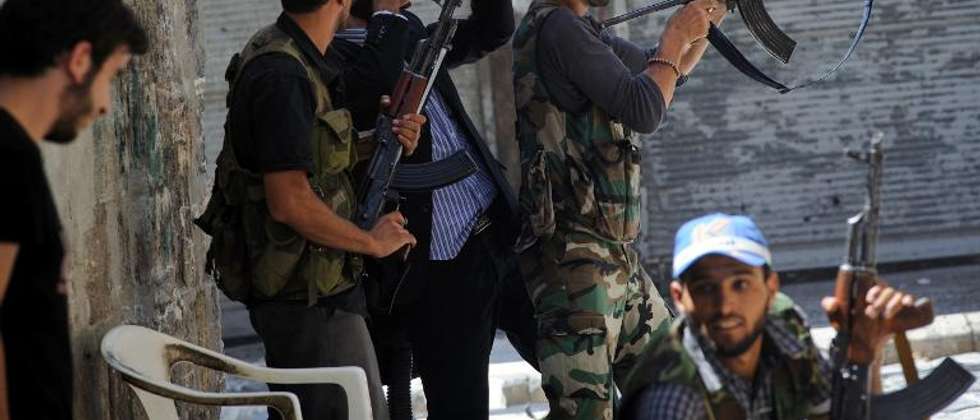
Witnesses said foreign and local fighters from extremist groups were the first on the scene to assist the injured. But the frantic and tragic atmosphere led to accusations as FSA members arrived. Omar described how shots were fired in the air as extremist fighters, in particular non-Syrians, were chased from the scene.
“They blame all the foreigners,” Omar said referring to foreign jihadist fighters. “In the first place they blame ISIS and they’re saying maybe it was done by the defected ISIS troopers who joined al Nusra recently after their problems.”
Locals say the atmosphere in Atmeh remains tense. The brief unity between the various rebel factions that prevailed over ISIS has been dealt a blow. Distrust is high.
To date, the Syrian conflict, which is about to enter its third year, has killed more than 140,000 and displaced over nine million Syrians. While 2.5 million live as refugees in neighbouring countries, a further 6.5 million have fled areas of heavy conflict to towns like Atmeh and now live in appalling conditions in tents or in over-crowded homes, according to USAID figures.

Last week, a Pakistani Taliban commander reported the execution of 23 Pakistani frontier troops held hostage; two weeks ago, a suicide bomber killed nine Shiite Muslims in Peshawar. In response, Prime Minister Nawaz Sharif’s government has conducted retaliatory airstrikes but has only suspended, not abandoned, its foolhardy strategy for peace: keep trying to talk the Pakistani Taliban into disarming, in exchange for halting military operations against them.
These peace talks will fail. They are an effort to surrender, and they ignore what most Pakistanis want: to regain control of their country from this deadly insurgency.
So Mr. Sharif should end the talks definitively and have the army mount a strong land offensive to drive the Pakistani Taliban out of their mountainous stronghold south of Peshawar once the snows melt this spring. It is there that the group poses the greatest risk toPakistan’s people, and to America’s supply line to Afghanistan. The United States should help the army prepare.
In the last decade, the Pakistani Taliban and associated groups, operating from the northwest, have terrified much of Pakistan. They have killed more than 18,000 civilians, including more than 2,000 Shiites and 5,500 police officers and soldiers. A sense of siege prevails west of the Indus River, even though that area is garrisoned by Pakistan’s military.
Much of the problem can be laid at the feet of Pakistan’s leaders. For decades, with government acquiescence, Pakistan’s military and its intelligence agency have used radical Islamist groups to foment insurgencies in Afghanistan and Kashmir. The groups recruit and train ideologues and fighters; raise funds; run seminaries and businesses; broadcast hatred of their political and religious enemies; and get hospital treatment when they are wounded. The military’s original goal was to counter Indian regional influence, but the cost to Pakistanis has been the failure of their state. Now the extremists increasingly target the very military that armed and encouraged them.
In other words, Pakistan’s luck has run out. You can sway an insurgent to fight “injustice” in a neighboring country like India, but once his leaders feel they have impunity, you can’t stop them from acting independently or exploiting local grievances. These days, as much as the Pakistani Taliban hate Indians and Americans, they hate other Pakistanis more. Acting in tandem with Al Qaeda, the Haqqani network, Lashkar-e-Taiba and other lethal groups, the Pakistani Taliban has slaughtered Shiites, Christians, Indians, Americans, Afghans and polio prevention workers, often with the state looking the other way.
Pakistan’s decade-long response has been based on a fallacy: that the military could target “bad” insurgents (those fighting Pakistan’s army and citizenry), while it worked with “good” ones (those fighting India). In reality, the two types are increasingly indistinguishable and have killed a great many times more Pakistanis than Indians. For example, Lashkar-e-Taiba, the group responsible for the 2008 Mumbai attacks, also has supported anti-Shiite death squads. And the Haqqani network, which has fought Indian influence in Afghanistan, has also helped Al Qaeda and the Pakistani Taliban kill Pakistanis.
Last year, a poll conducted by the Pew Research Global Attitudes Project found that 93 percent of Pakistanis said terrorism was a big problem, while only 45 percent worried that much about Indian influence in Afghanistan. Nevertheless, peace efforts have kept chasing the dream of compromise. In 2004, 2006 and 2008, Pakistan’s army signed deals that gave insurgents territory, amnesty, reparations, exemption from constitutional rules — along with time to rearm, regroup and resume their attacks. The record of mayhem, which has included attacks on major military headquarters, has left one mediator defending the current talks with this logic: “If America, with all its might, couldn’t win in Afghanistan, how can we win against the Pakistani Taliban? They have scores of suicide bombers. We must negotiate.”
But that is nonsense. Of course Pakistan’s army can’t expect to win the war by simply killing enough of the enemy. It must also focus on winning over the local populace by assuring their safety. But the army showed in 2009 that it could do this: After the Taliban seized the peaceful Swat Valley and proceeded to behead policemen, flog women and keep girls like Malala Yousafzai from attending school, the army swept in. Aided by new training and tactics, and with an infusion of American dollars and equipment, the troops took back the area and then kept control of it — a first for them since 9/11. And most of the two million displaced residents returned home.
Today, most Pakistanis want to apply the “Swat Valley model” to North Waziristan, the nerve center of the Pakistani Taliban. Prime Minister Sharif, in a Jan. 29 speech defending negotiations, admitted as much. “I know if the state today decides to use force to eliminate the terrorists, the entire nation will support it,” he said.
What he should have added was that peace talks would make the most sense after Pakistan’s troops took the area from the insurgents. Today, the Taliban demand nothing less than blanket immunity, a return of prisoners, the exit of all Pakistani troops, an end to American drone strikes, the abandonment of secular education and the severance of ties between the United States and Pakistan. Defeating them in battle might allow Pakistan to demand, instead, that the Taliban accept the rule of law.
That outcome would benefit the United States. We need Pakistan as a strategic ally, and we need both its stability and a good working relationship with its leaders to help keep its 100 or so nuclear warheads from falling into terrorist hands. Nevertheless, our relationship has been strained for decades by mutual distrust — largely traceable, on the American side, to Pakistan’s reluctance to directly confront the dangerous partners it has coddled for so long.
So in preparation for a spring offensive, America should now offer Pakistan intelligence, surveillance and reconnaissance support, as well as humanitarian assistance for those citizens whom fighting would inevitably displace. It is an opportunity to start building trust between our two countries by helping Pakistan take on its worst internal threat, one that menaces the democracy that Pakistanis crave.

Taliban’s claim of slaying 23 Frontier Constabulary (FC) personnel has torpedoed the peace parleys as government negotiators put off their Monday meeting with TTP-nominated team, and the civilian and the military leadership reportedly decided to launch a decisive action against the terrorists.
The meeting of the peace negotiators was cancelled on the directives of the prime minister, who told the government negotiators that such gruesome acts of terrorism could not be tolerated and that in the face of such terrorist activities the peace talks have become meaningless.
“The lives of our children are extremely precious,” he said in a meeting with Irfan Siddiqui and Maj (r) Amir on Monday morning. The PM said that the killing of the security personnel could not be allowed in the garb of negotiations. The terrorists through their negative tactics have sabotaged government efforts to negotiate peace, he added.
The peace process has gone into disarray just two weeks after the talks began, when Sunday night TTP claimed to have killed 23 FC men they had kidnapped in 2010.
A media report said that a gruesome video was released on Monday by the terrorists, showing beheaded bodies of FC men being thrown out of a pickup van. The report, quoting army sources, said 26 bodies of the martyred soldiers had been found near the Pak-Afghan border later in the day.
TTP Mohmand chapter chief Umar Khalid Khurasani in a letter posted on the social media had said the FC men had been killed to avenge the killing of their men in government custody in various parts of the country.
Spokesman for the main TTP group, Shahidullah Shahid had earlier declined to confirm the killings but said “it might be a reaction to the killing of our 23 comrades in Karachi and Nowshera”. The TTP spokesman alleged their under-custody members were being killed in the name of targeted operation. He claimed that 23 Taliban members had been killed during the ongoing dialogue process –15 in Nowshera and 7 in Karachi.
Sources said the government and the military leadership has decided in principle not to hold talks any further with the Taliban and started preparations for launching a decisive action against them. They said the civil and military leadership in a high-level meeting late Sunday night decided to launch operation in North Waziristan.
According to sources, the security forces are fully prepared for action in Waziristan and are waiting for a green signal to go after terrorists. During the meeting, the prime minister said no compromise would be made on national security and no concession would be made to the terrorists. The meeting reportedly decided that the security forces will not halt their action against terrorist elements. It was decided that ground and air attacks will be conducted against the terrorists.
Special Assistant to Prime Minister Irfan Siddiqui during their meeting informed the PM that the government committee would meet on Tuesday (today) to review the changed situation. Sources in government informed that the committee would again meet prime minister who would then take a ‘final decision’ on what exactly to do with the dialogue process.
Sources also said that now the voices in favour of military operation against Taliban have grown phenomenally in the echelons of power, as the supporters of peace through dialogue have no answers to the stepped-up terrorist activities by the TTP. The argument that TTP is a loose alliance of several dozen militant groups and the central leaders of the conglomeration have little hold on majority of these groups appears to be not holding water. Many a question are being asked about the use of talking to the so-called TTP shura leadership if it has no control or doesn’t exercise it over the smaller groups.
The meeting of government- and TTP-named negotiators was scheduled for Monday in Akora Khattak, home town of Samiul Haq, who heads the Taliban designated team. But the government negotiators, Irfan Siddiqui, Amir Khan, Rahimullah Yusufzai and Rustam Shah Mohmand met in Islamabad and cancelled the meeting which had one-point agenda of ceasefire.
After this development, Taliban-named team comprising Samiul Haq, Yousaf Shah and Prof Ibrahim Khan also held a meeting at Akora Khattak and expressed their concerns over the slaying of FC men and cancellation of the meeting. Speaking at a news conference there, Yousaf Shah said that they also condemned the Mohmand Agency incident but they will not go into details over the explanations provided by the TTP.
He said it’s been heard that the government has decided to conduct operation, adding that the problems will never be resolved through force. He said military operation is not an option to restore peace in the country. He said the government shouldn’t stop the process of dialogue, and that cancellation of Monday’s meeting was disappointing.
In the same press conference, Prof Ibrahim said their committee was a neutral body acting as a bridge between the government and the TTP. He said the negotiators from both side should have met and discussed the issue. “It is sad that the government negotiators have considered us as TTP representatives and refused to meet us; we don’t consider ourselves separate from the government representatives,” he said.
Yousuf Shah in his media talk claimed there were positive signals coming from the Taliban side and they were close to ceasefire and the government should have met them. He said that Sami would soon contact Taliban and then Taliban negotiating committee would soon issue a formal statement over the attack.
TTP’s main spokesman Shahidullah, who conceded that killing of FC men by their associates might have been a reaction to the killing of captured Taliban, said that such actions by the government during talks were unbearable and harming the dialogue process. Claiming that TTP was serious and sincere in holding talks he alleged the government was making the dialogue process difficult. He said they have been thinking about the declaration of ceasefire for making the dialogue a success, but “we are reluctant because of the government actions”.
A security official said the TTP allegation of killing of terrorists in the security forces’ custody was a baseless propaganda to justify their brutal acts of terrorism. He said the killing of policemen in Karachi, FC personnel in Mohmand Agency and other continuing acts of terrorism testify that Taliban were insincere and they were advancing their bloody agenda in the garb of peace process.
In a statement issued by PM Office on Monday, the prime minister said incidents like that of martyrdom of FC personnel in Mohmand Agency cast negative impact on peace talks. “Pakistan can’t afford bloodshed anymore,” he added. Paying rich tributes to the sacrifices of the martyrs‚ he said the government initiated the dialogue process with good intentions in the light of the decisions of All Parties Conference (APC); however‚ the process is sabotaged whenever we reach an encouraging point. He said that it was highly regrettable situation and the entire nation was grieved over it.

KAREEM KHAN, WHO SUED GOVERNMENT OVER DRONE ATTACKS, WAS DUE TO ADDRESS EUROPEAN PARLIAMENTS NEXT WEEK.
An anti-drone campaigner has “disappeared” from Rawalpindi days before he was due to testify before European parliaments, his lawyer said on Monday, accusing Pakistani intelligence agencies of illegal kidnapping.
Kareem Khan, whose brother and teenage son were killed in a drone attack in December 2009, was picked up at his home by security forces in the early hours of Feb. 5 and has not been heard from since, Shahzad Akbar, a lawyer representing him said.
Akbar said 15 to 20 men, some wearing police uniform and others in plainclothes, seized Khan, who was the first Pakistani to sue his government over the drone attacks that resulted in the deaths of his relatives. “We lodged a report with the local police but they denied having picked him up. I checked with the central office of the police and they have no such arrest in their record, it seems to be work of the intelligence agencies,” Akbar said. “The men did not disclose their identities and no reason was given for the detention. Mr. Khan’s wife and young children were present at the time, as was a neighbor,” he added.
A senior police official who requested anonymity because of the sensitivity surrounding the case denied the force had arrested Khan, who is in his fifties and hails from the North Warizistan tribal area. “The Rawalpindi police has not arrested anybody from the tribal area, in fact we had no ‘raid’ on record on that night,” the official said.
Khan had filed a case against the Pakistani government petitioning the court against drone strikes, arguing they constitute murder under domestic law. The next hearing date before the Islamabad High Court is scheduled for Tuesday.
He was also due to travel to Europe this Saturday to speak with German, Dutch and British parliamentarians about his personal experience with drone strikes and the impact they are having on his country.
According to an AFP tally, 2,155 people have been killed in drone attacks since August 2008, with critics charging that the strikes cause many civilian casualties. The U.N. General Assembly passed a resolution in December 2013 calling on states using drone strikes as a counter-terrorism measure to comply with their obligations under international law and the U.N. Charter.
Clare Algar, executive director of the legal charity Reprieve, said: “We are very worried about Mr. Khan’s safety. He is a crucial witness to the dangers of the CIA’s covert drone program, and has simply sought justice for the death of his son and brother through peaceful, legal routes.”
She added: “Reports that he was detained by men in police uniforms are of great concern, and we urge the Government of Pakistan to do everything in its power to secure his immediate release.”
Akbar, the lawyer, gained prominence after disclosing the identity of the then CIA station chief in Islamabad in 2010 in an application filed in a Pakistani court against him for his alleged role in drone strikes. The case sparked loud criticism from Washington who accused Pakistan’s intelligence agencies of leaking the name of the spy chief, who was later called back to Washington.

Syrian rebels have breached part of Aleppo’s central prison, releasing several hundred inmates in a bloody skirmish with regime troops, activists reported Thursday.
The prison, which the rebels have had under siege for almost a year, has become a Syrian army base but still has up to 4,000 prisoners languishing in its cells, disease-rived and starving.
Up to 300 prisoners were released in the operation, led by Jabhat al-Nusra, a group affiliated with al-Qaida, and Ahrar al-Sham, according to the Syrian Observatory for Human Rights.
The rebels were forced to fall back when regime troops counter-attacked, dropping barrels filled with TNT from helicopters, activists in Aleppo said. The counter-attack reportedly killed the Nusra commander, who went by the name Saif Allah. Photographs of his body on a stretcher circulated on Twitter.
Yesterday’s attack began when a bomber from Nusra blew himself up at the gates. Rebel fighters swarmed in, fighting corridor by corridor to take over much of the compound.
Families and friends of prisoners waited anxiously for news, afraid that the fighting might kill their loved ones, but hopeful that this was also their chance to be released. “I have four nurses imprisoned there,” said a doctor in an opposition-held part of Aleppo. “Their crime was caring for patients in field hospitals in Aleppo.”

Even with all the optimism about the global economy here last week at the annual meeting of the World Economic Forum, there was a remarkable economic and political risk that appeared to have been largely overlooked: The long-simmering battle between China and Japan may be close to boiling over. One top executive went so far as to describe the nations’ relationship as a “stealth war.”
The implications for the global economy — and some of the largest multinational companies — are profound. China and Japan represent the second- and third-largest economies in the world, after the United States, and they are among each other’s largest trade partners. General Motors,Microsoft, Boeing, Nike, Coca-Cola and Procter & Gamble, among others, have huge businesses in both countries.
“I probably spoke to no less than 40 U.S. C.E.O.’s here and I would say this issue came up in more than half of those conversations,” said Ian Bremmer, the political scientist who founded the Eurasia Group, the political risk consulting firm. “This week at Davos, for me, the big takeaway was that China-Japan was much more problematic than we thought. The possibility that you get anti-Japanese sentiment in a big way and it causes real disruption on trades and hurting both economies is real.”
If you need evidence of the significance of this geopolitical clash, look no further than the surprising comment made here by Prime Minister Shinzo Abe of Japan, who said his country’s relationship with China was in a “similar situation” to the one between Germany and Britain before World War I.
Mr. Abe was trumped by Wu Xinbo, a Chinese university dean who is considered close to China’s leadership, when he described Mr. Abe as a “troublemaker” and, at one point, compared him, somewhat obliquely, toKim Jong-un, the North Korean dictator.
“I have to say that the political trust between the two countries now is very low,” Mr. Wu said, suggesting that he expects “political relations between our two countries will stay very cool, even frozen, for the remaining years of the Abe administration in Japan.”
Problems between China and Japan have long been festering, especially as Mr. Abe has sought to rewrite the country’s Constitution and build the country’s military, which has long been considered only defensive.
Tensions rose when China angered Japan last November when it claimed an air defense identification zone over a chain of islands in the East China Sea that the countries have disputed claims over. The conflict increased after Mr. Abe visited the Yasukuni Shrine, where Japanese war dead are commemorated, including several war criminals who were executed after Japan’s defeat in World War II. The trip offended many Chinese, and the Obama administration had warned Mr. Abe not to visit the shrine.
China-Japan political relations have been strained since the end of World War II. Previous visits by Japanese politicians have angered China and South Korea, which both suffered greatly under Japan’s empire-building efforts then. And the Japanese citizenry has often sought to distance itself from its imperialist past, preferring instead to highlight the nation’s economic progress and prowess.
Yet now, the intensity of the feelings of mutual distrust is striking. According to Pew Research, just 1 in 20 Japanese “have a favorable attitude toward China” and “anti-Japan sentiment is quite strong in China, where 90 percent of the public has an unfavorable opinion of Japan.”
The latest tensions are having a direct economic impact; the Japanese, for example, are investing less in China.
Mr. Bremmer, of the Eurasia Group, put it bluntly: “The Chinese have written off Shinzo Abe as someone they can potentially work with. They mistrust him completely. They believe he is belligerent toward them and believe an escalatory policy is the appropriate one to pursue.”
After Mr. Abe made his comment comparing his country’s relationship as being similar to Britain and Germany in 1914, when the two countries were major trading partners, China’s leaders made their own attacks. “Rather than using pre-World War I Anglo-German relations, why don’t you deeply examine your mistakes during the First Sino-Japanese War, the Japanese colonial rule of the Korean Peninsula and the fascist war that Japan launched on victim countries in World War II?” Qin Gang, a spokesman for China’s foreign ministry, asked of Mr. Abe.
Mr. Abe, in fairness, did try to play down any hints that the simmering tensions would lead to a prolonged military conflict.
“Japan has sworn an oath to never again wage a war,” Mr. Abe said in his speech. “We have never stopped, and will continue to be wishing for the world to be at peace.”
But that’s not what many of the executives and regulators I spoke to after his presentation took away from his comments. “I’m going to be asking our teams in China and Japan to do a full analysis of the risks to our business when I get home,” one Fortune 500 C.E.O. told me, seeming anxious. “Maybe this should have been on my radar before, but it is now.”
So what’s the biggest risk?
“The possibility of a mistake where someone gets killed is going up,” Mr. Bremmer said. “They are scrambling their fighters in the East China Sea every day.”
And the misunderstandings could deepen. “More problematically, the aftermath of a mistake will have both countries actively mistrusting the intentions of each other without a mechanism to really talk to each other and without the Americans acting as an interlocutor,” Mr. Bremmer said.
Mr. Wu said that the possibility of war was overstating the case: “China doesn’t want to fight a war.”
One of the greatest challenges multinational companies doing business in the region may face is that the United States government may not be positioned to step into the middle of the debate. Many of the American officials who were closest to Japan have left the Obama administration. Hillary Rodham Clinton, Kurt Campbell and Tom Donilon — all known for being the architects of President Obama’s “pivot” toward Asia — are no longer there, nor is Timothy F. Geithner, who worked in Japan in the 1990s and had close relationships with many senior leaders.
“Kerry doesn’t really do Asia,” Mr. Bremmer said about Secretary of StateJohn Kerry, who would most likely take umbrage at that assertion. “Susan Rice? No,” he said of the United States ambassador to the United Nations.
“Who is paying attention to foreign policy in Obama-land or in Congress? Nobody.” Whether that is true or not, it is clear that China, long seen as a fast-growing economy, and Japan, which has experienced a rebound in the last year, now should be added to the list of political and economic risks that businesses should consider in 2014.
Iraq on Thursday hanged 11 people convicted of terrorism-related offenses, the Justice Ministry said, pursuing what a U.N. official has criticized as a “conveyor belt of executions.”
All those executed were Iraqi nationals, Justice Ministry spokesman Haider al-Saadi said in a text message. The hangings brought the total number of people executed in less than one week to 37.
Violence in Iraq has surged in the past year to its highest levels since the Sunni-Shiite sectarian bloodshed that peaked in 2006 and 2007, when tens of thousands of people were killed across the country.
Police said Thursday that they had thwarted an attack against a meeting of the provincial council in the central province of Diyala, killing seven suicide bombers and dismantling five car bombs that were apparently to be used during the foiled assault.
Gunmen also attacked an Iraqi army base in Baghdad’s Abu Ghraib neighborhood, killing two soldiers, and a roadside bomb exploded when a minibus was passing near Tarmiyah, north of the capital, killing another person, police said.
Iraq hanged at least 151 people in 2013, up from 129 in 2012 and 68 in 2011, New York-based Human Rights Watch said in its annual world report, which was published Tuesday.
The United Nations’ human rights chief, Navi Pillay, has frequently condemned Iraq’s mass executions.
“This continued conveyor belt of executions by the government of Iraq is simply deplorable,” her spokesman, Rupert Colville, said Sunday after 26 people were hanged.
“Iraq’s justice system still has huge deficiencies which mean that resorting to even a small number of executions is risking a grave and irredeemable miscarriage of justice,” Colville said. “When people are executed by the dozen, it means that such miscarriages of justice are virtually certain to be occurring.”
At first glance, the training camp appears no different from the many others shown in propaganda videos posted by al-Qaeda’s affiliate in Syria. Hooded recruits in camouflage shoot at targets or march in formation under the black flag of the Islamic State of Iraq and Syria.
But look closer and the “fighters” appear quite small. The tallest are barely chest-high to their instructors, and the shorter ones wear ill-fitting uniforms and appear to struggle under the weight of their weapons. A photo of the recruits without their hoods confirms that all of them are young boys.
They are “Zarqawi’s Cubs,” the youth brigade of Syria’s most fearsome Islamist rebel group and one of the newest manifestations of al-Qaeda’s deepening roots in rebel-controlled sections of the country. Building on earlier efforts to expand their influence in Syrian schools, radical Islamists appear to be stepping up efforts to indoctrinate and train children, some as young as 10, according to independent experts who have studied the phenomenon.
The establishment of the Zarqawi’s Cubs camp — revealed in a video posted last month by the Islamic State of Iraq and Syria, or ISIS — is viewed as particularly worrisome because of the similarities to Iraq’s “Birds of Paradise.” That brigade was created a decade ago by the same terrorist group, in its earlier incarnation as al-Qaeda in Iraq, to train children for military missions, including suicide bombings.
“This is the future threat,” said Steven Stalinsky, executive director of the Middle East Media Research Institute, a Washington nonprofit organization that has tracked the exploitation of children by Syrian fighting groups over the past two years. “These are the children of al-Qaeda.”
U.N. agencies and human rights groups have accused multiple Syrian factions — including secularist rebels and pro-government militias — of recruiting children for military roles ranging from scouting to actual combat.
Researchers from Human Rights Watch interviewed boys as young as 14 who were used to transport weapons or serve as lookouts. Even younger children were put to work loading bullets into magazines for assault rifles, said Sarah Margon, acting director of the group’s Washington office.
“It’s something that children often do because their fingers are smaller,” Margon said. But such practical considerations aside, “for those looking to indoctrinate, it is a ripe setting for indoctrination,” she added.
The Obama administration last year imposed restrictions on some of its nonmilitary aid to Syria in part because of concerns about the use of child soldiers. Invoking a 2008 law forbidding assistance to countries that use child soldiers, the administration approved restrictions on certain types of nonmilitary aid to Syria as well as the Central African Republic, Burma, Sudan and six other countries, according to State Department documents.
The appearance of training camps for young boys suggests a more systematic effort to incorporate the youngest Syrians into the conflict, as ideological supporters and as combatants in a religious war against a regime led by the country’s minority Alawites, members of an offshoot of the Shiite branch of Islam, according to experts who study jihadist groups.
Radical groups often post images on social media that highlight the role played by children, and some attempt to tailor their messages to appeal to the very young, said Aaron Zelin, an expert on jihadist groups at the Washington Institute for Near East Policy.
“They understand that they are the future and, therefore, need to be exposed and indoctrinated to the ‘cause,’ ” Zelin said. It explains why some groups operate age-based training camps that start with “cubs” and progress to “lion scouts” for older teens and adults, he said.
The ISIS youth group was named in honor of Abu Musab al-Zarqawi, the Jordanian who founded al-Qaeda in Iraq, a group notorious for its spectacular suicide bombings targeting Shiite mosques and bazaars in Iraq’s Shiite neighborhoods, as well as its videotaped beheadings of Western hostages. Zarqawi, killed in a U.S. airstrike in 2006, remains an inspirational figure for Islamist extremists worldwide, as well as the ideological father of ISIS and other al-Qaeda-allied rebel groups in Syria, including Jabhat al-Nusra.
The video depicting the Zarqawi’s Cubs camp describes the location of the facility as near Ghouta, the same eastern suburb of Damascus that was struck in a chemical-weapons attack in August that killed more than 1,000 civilians. Much of the region has been held by rebels for months, despite intense fighting in some villages.
The boys are shown being led by masked instructors through small-arms exercises and sitting in groups under the ISIS banner, some of them weighed down by bandoleers of machine-gun ammunition. Other images show the boys undergoing instruction or, in one instance, talking happily over a lunch of flatbread. Beverages are distributed in colorful cups adorned with the cartoon “happy face.”
In the soundtrack, Arab voices sing a mournful song. “Oh mother, don’t be saddened by my leaving,” it says at one point, explaining that the boys are going away to fight “for the sake of defeating the Jews.”
Experts who viewed the video said it appeared authentic, though precisely when and where the images were recorded could not be established with certainty. Nor is it clear how many children are being trained.
Others who have tracked the recruitment of children by Syrian militant factions see the latest initiatives as intended mainly to indoctrinate young Syrians raised in a country that has a long tradition of secularist rule. The emergence of training camps for youths comes on the heels of school-outreach programs by both ISIS and Jabhat al-Nusra, which control swaths of northern and eastern Syria. Both organizations have posted videos on Twitter and YouTube showing visits to Syrian classrooms by armed militants, who hand out Islamic textbooks, as well as food and gifts.
Another self-identified ISIS video, posted in late November, shows a man in conservative Arab dress leading several dozen children in Syria’s Aleppo province in denouncing a list of “infidels,” including Syrian President Bashar al-Assad and President Obama.
“Imagine we had here with us an Alawite, from al-Assad’s family or religion. Would we like him?” asked the leader in Egyptian-accented Arabic.
“No,” the children replied.
“What would we do with him?” the leader asks.
“Slaughter him,” came the answer, in unison.
The speaker congratulates his young listeners. “Slaughter him, right. Because he is an infidel,” he says.

DGMOs of India and Pakistan will meet at the Wagah border on 24 December to discuss ways to ensure ceasefire on the Line of Control, three months after Prime Minister Manmohan Singh and his counterpart Nawaz Sharif proposed this meeting to defuse tensions. The meeting of the Director Generals of Military Operations(DGMO) was proposed by Pakistan today and India accepted it.
The meeting will be held on the Pakistan side of the Wagah border on 24 December, Indian Army Headquarters said in New Delhi. “Pakistan Army DGMO has extended an invitation to his Indian counterpart for the meeting on 24 December,” a senior official of the Pakistan Army’s media arm said in Islamabad. The Pakistan Foreign Office said in a statement that the invitation was extended to “strengthen the mechanisms to ensure ceasefire on the Line of Control”. No details were given by the military or the Foreign Office about the venue of the meeting. The invitation was extended by the Pakistani DGMO soon after Sharif chaired a meeting of the Cabinet Committee on Security to discuss national security issues. At the meeting, the Indian side will be represented by DGMO Lt Gen Vinod Bhatia while Pakistan will be represented by his counterpart Maj Gen Amir Riaz. The two DGMOs usually talk to each other on hotline on Tuesdays. On 29 September, Singh and Sharif agreed on a meeting between the DGMOs during their talks on the margins of the UN General Assembly meet in New York. The premiers felt a meeting between the top Army officers would help reduce tensions on the LoC that were at a peak following the killing of five Indian soldiers in an attack in August amid a series of ceasefire violations by Pakistan. However, the meeting was not scheduled and both sides did not give reasons for the delay. The strained bilateral relations took a hit early this year when two Indian soldiers were killed by Pakistani troops along the LoC in January. Fierce exchange of fire on the ceasefire line led the two countries to accuse each other of violating a 2003 ceasefire agreement.


 Posts
Posts

