Showing posts with label France. Show all posts

Bankrupt France eager to continue meddling in Africa’s affairs

Posted by FS On Saturday, 11 January 2014 0 comments

Dakar (AFP) - A year after dispatching warplanes and troops to repel an Islamist incursion in Mali, France is fighting in another of its former colonies, demonstrating it is destined to play reluctant "gendarme" in Africa, say analysts.
With the Mali intervention deemed a success by the international community, France is withdrawing most of its soldiers but has launched another operation in the Central African Republic (CAR) to stop escalating inter-communal religious conflict.
France's Defence Minister Jean-Yves Le Drian has welcomed the achievements of Operation Serval, launched on January 11, 2013 to drive militants linked to Al-Qaeda out of Timbuktu and Mali's other northern cities.
The country has been "liberated" and the mission's success was "universally recognised in the international arena", he said on a New Year's Eve visit to Mali.
But he struck a more solemn tone two days later in Bangui, where the principal task was to boost the morale of troops bogged down in the quagmire of the CAR crisis.
About 7,000 French soldiers have been deployed in UN-backed military and humanitarian missions in Mali and the CAR.
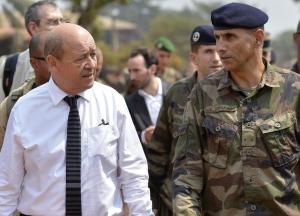
'The gendarme of Africa'
"Broadly, you'd say -- and this has been the case for quite some time -- that France finds itself obliged to intervene and is, despite itself, the gendarme of Africa," said Bruno Tertrais of the Paris-based Foundation for Strategic Research.
With nearly 6,000 men permanently stationed across the continent, France is uniquely placed to act quickly when law and order break down and regimes collapse.
Its deployment is organised around two main poles, Libreville in the west (940 troops), and Djibouti in the east (2,000) and it also has troops in Chad (950), Senegal (350) and Ivory Coast (450), as well as special forces stationed notably in Niger.
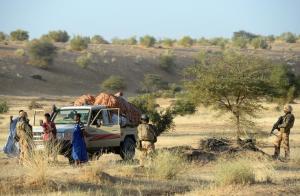
With the gradual return to stability in Mali, the emergence of the CAR crisis and the more general threat of Islamist terrorism across the vast, ungovernable Sahel region, France is in the process of redrawing its military presence across Africa.
"I'm seeing the heads of state to discuss with them how we will in the coming months... reorganise and expand our presence geographically in Africa," Le Drian said Thursday last week in Bangui.
France intervened in Africa 19 times between 1962 and 1995, often to sway a state's internal politics under the murky "francafrique" system put in place by Charles de Gaulle to maintain political and business interests in the former colonies.
But it began to adopt a more multilateral approach under Jacques Chirac's 1995 to 2007 presidency, eschewing political meddling in favour of backing United Nations and African Union peacekeeping operations when crises arose.
In 2003 and 2008, France led European Union operations respectively to combat rebels in north-eastern Democratic Republic of Congo and to secure the Central African and Chadian borders with Sudan's Darfur region.
France went into Ivory Coast in 2011 to help fighters loyal to election winner Alassane Ouattara arrest defeated former president Laurent Gbagbo and in the same year led an intervention in Libya to support rebels fighting Moamer Kadhafi.
Current President Francois Hollande underlined the new approach in a speech to Senegal's parliament in October 2012, vowing that the days of francafrique were over.
The broad approval both in Africa and in the West for France's intervention in Mali has created a climate which makes its operation in the CAR more palatable to its former colonies.
'Barbarian forces'
A year after Operation Serval was launched, the government in Bamako has reasserted itself through nationwide polls which saw former premier Ibrahim Boubacar Keita elected president and parliament reopened.
"At the institutional level, all is well... On the security front, things are more mixed," Bamako-based political analyst Souleymane Drabo told AFP.
"Overall security is largely restored in the regions of Timbuktu and Gao but there are still sporadic terrorist activities taking place there," he added.
The challenge for Mali now is to seek a peaceful settlement with its Tuareg separatist movement, restore its authority in the rebel bastion of Kidal and wipe out the Islamist insurgency.
The economy is also an urgent issue in a country ravaged by conflict and ranked 182nd of 187 nations in the 2012 Human Development Index.
In his New Year address, however, Keita put Mali's ongoing woes in perspective, recalling that before France's intervention "three-quarters of the country was in the hands of barbarian forces, jihadists... (who) did not think twice about rape, amputations, floggings, stonings, vandalism, executions".
Paul Melly and Vincent Darracq argued in a paper for the Chatham House think-tank published last year that Hollande's Africa strategy has amounted to rather more than the military action in Mali.
"He has attempted to refashion France's wider political approach towards the continent and make a distinct break from the message and policy priorities of the Sarkozy era.
"President Nicolas Sarkozy was self-confident and direct, but Hollande has shown a subtler ear for the tone of African diplomacy and how this can be used to productive effect."
READ MORE

What are France’s motives behind pushing Iran away?

Posted by FS On Saturday, 16 November 2013 0 comments

When Iranian Foreign Minister Mohammad Javad Zarif visited Paris last week and held talks with his French counterpart Laurent Fabius on Iran’s disputed nuclear programme, he probably never thought the main opposition to an Iranian proposed agreement to resolve its nuclear standoff, would come from the French three days later.
The US and its allies narrowed their differences with Tehran after three days of marathon talks in Geneva, but announced they had failed to produce an interim deal due to yet unresolved differences.
“A lot of concrete progress has been achieved, but some differences remain,” European Union foreign policy chief Catherine Ashton told reporters in Geneva, Switzerland.
Still hopeful
Also addressing reporters at the end of the talks was Zarif, who said, “We are all on the same wavelength, and that gives us the impetus to go forward when we meet again.”
US Secretary of State John Kerry had a similar message, “There’s no question in my mind that we are closer now, as we leave Geneva, than we were when we came, and that with good work and good faith over the course of the next weeks, we can in fact secure our goal.”
With the next round of talks set for November 20 in Geneva, it was announced on Sunday, that the US Congress will push for a new round of sanctions on Iran, and also outline acceptable conditions for a deal with Iran now that the Geneva talks have failed.
The talks were very close to a final deal on Friday, but complications surfaced after France raised questions, saying it believed the proposal did not adequately neutralise the risk of Iran making a nuclear bomb.
Different viewpoints have been expressed on the motives behind France’s intervention to prevent a deal, ranging from commercial and geopolitical interests, to just playing a role as a scapegoat for the US.
With respect to the P5+1, the French stance challenged efforts made by the group to sit at the negotiation table. There have been comments that by doing so, France, in fact, strengthened Iran’s position because despite all problems, Iran has always been ready to attend the talks to settle the case, and hammer out a deal. However, US conservatives and Israel, in the previous rounds of talks, and now, in this round, France, have rejected diplomacy and continue to play the military confrontation, “all options are on the table”, card.
Suspect motives
By taking a tough stance against Iran, France can appease the Gulf states, especially Saudi Arabia, which fears Iran’s increasing regional power. Its reward is more financially lucrative contracts and sales of more arms to these countries.
Francois Heisbourg, a former French official and now chairman of the International Institute for Strategic Studies has said that in domestic politics, “standing up to the Americans will increase popular ratings of President Francois Hollande’s government”, even though the Iranian nuclear issue isn’t especially important to the French public.
There are speculations in Tehran that Hollande hopes that what he did at this round of talks, might lead to a stronger deal to be discussed during the November 20 Geneva meeting. This will surely make the hawks in Washington happy, too.
Conservatives in Tehran believe that France was playing its role within the group. It is believed that France was given the role of  a “spoiler” in an orchestrated move. Because of the distrust between Tehran and Washington would have grown deeper, had the US played this role.
Statements made by US and British officials put weight behind such belief. In comments on “Meet the Press” on Sunday, Secretary  Kerry again downplayed the idea that France had undermined the deal, saying that the US too wanted more “clarity” about the terms of the deal and that the six powers remain united.
Presence of the Israeli lobby in French diplomacy is another reason mentioned for Fabius’ change of heart. It is also believed in Tehran, that the French intend to get more concessions. One should not forget that rivalry among big powers to take over global markets, has been the root cause of two world wars.
Economic concerns
Additionally, France’s anti-Iran move has roots in the economy. The French are worried they might lose the vast and lucrative Iranian market. France has benefitted considerably from the sanctions placed on Iran. It has sold its outdated auto technology to the country, and has been active in the oil and gas sectors. The French know the US will have an eye-catching presence in Iran’s market once the sanctions are lifted, so they intend to pave the ground, in the talks with the US, for having a share in Iran’s significant market.
Kerry, Lady Ashton and Zarif have voiced strong optimism that a deal would be reached on the nuclear standoff in the next round of talks, and that would pave the way for a thaw in relations between Iran and the West. In which case, where would France stand, considering the fact that Iran picks its economic partners on the basis of its long-term interests?

READ MORE

France recognizes Syrian Opposition as people’s representatives

Posted by FS On Wednesday, 14 November 2012 0 comments

France has become the first Western power to recognise the newly united Syrian opposition as the only representative of the Syrian people. “France recognises the Syrian National Coalition as the...
France has become the first Western power to recognise the newly united Syrian opposition as the only representative of the Syrian people.
“France recognises the Syrian National Coalition as the only representative of the Syrian people and therefore as the future provisional government of a democratic Syria,” President Francois Hollande told a press conference in Paris on Tuesday.
The question of arming the rebels would be looked at as soon as the rebel coalition formed a transitional government, Hollande said.
“On the question of weapons deliveries, France did not support it as long as it wasn’t clear where these weapons went,” Hollande said.
“With the coalition, as soon as it is a legitimate government of Syria, this question will be looked at by France, but also by all countries that recognise this government.”
The announcement comes after opposition groups agreed on Sunday in Doha to unite against the regime of President Bashar al-Assad.
The French move comes 24 hours after the coalition was recognised by the six member states of the Gulf Cooperation Council – Saudi Arabia, Qatar, Bahrain, United Arab Emirates, Kuwait and Oman.
Pledging support
Arab League and European Union foreign ministers pledged after their meeting in Cairo on Tuesday to support the Syrian opposition and welcomed steps to unite the various groups under a new, united banner, in order to facilitate a solution to the 20-month conflict.
“The ministers welcomed the formation of the Syrian National Coalition for Opposition and Revolutionary Forces. They called on all opposition groups to adhere to the national coalition and on the national coalition to engage with all sections of Syrian society,” said a statement issued at the close of the meeting held in Cairo on Tuesday.
Syria’s divided opposition had come under pressure from Western powers to join forces and offer a single interlocutor during negotiations, in order to provide a single contact for international critics of the regime’s efforts to stamp down the opposition since 2011.
The coalition brings together the Syrian National Council and other groups inside Syria.
The Arab League has recognised the coalition as “the legitimate representative of the Syrian people’s aspirations.”
Secretary General Nabil al-Arabi described it as “a glimmer of hope.”
Frustration at UN deadlock
British Foreign Secretary William Hague called on the group “to demonstrate they are acting on behalf of all Syria’s communities. The more progress the coalition makes towards those goals, the greater practical support it will have from the United Kingdom.”
Hague expressed frustration at the deadlock on Syria in the UN Security Council, saying that “our efforts … to encourage the UNSC to take on its responsibilities have been vetoed by Russia and China. In the absence of such progress, we will increase our support to Syrian opposition groups.”
Moscow and Beijing, both allies of Syrian President Bashar al-Assad, have vetoed three Western-and Arab-backed resolutions at the Security Council condemning the Syrian regime for violence.
German Foreign Minister Guido Westerwelle said his country “is ready to join hands with the Arab League to help (the new alliance) to become a credible and inclusive alternative to al-Assad’s regime.”
Westerwelle and French Foreign Minister Laurent Fabius both met the head of the coalition, Mouaz al-Khatib.
READ MORE